
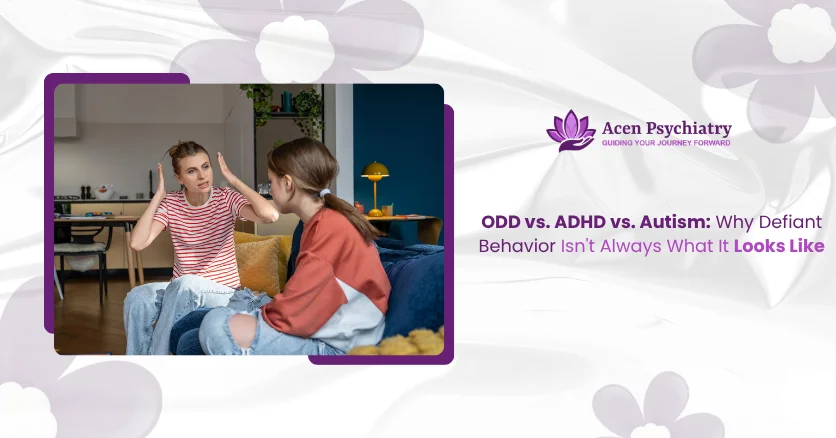
If you’ve searched for help with a defiant, explosive, or seemingly noncompliant child, you’ve probably noticed that
ODD, ADHD, and autism all get mentioned in the same breath — sometimes because they overlap, and sometimes
because what looks like defiance is actually something else entirely being misread. Untangling which one (or which
combination) is actually driving your child’s behavior matters enormously, because the right intervention depends on
getting this right.
Why These Get Confused
On the surface, a child melting down when asked to stop a video game, refusing to follow instructions, or arguing about
every request can look identical regardless of the underlying cause. But the reason behind the behavior is often very
different — and that reason changes what actually helps.
ODD: Defiance Rooted in Emotional Reactivity and Power
In ODD, the core pattern is anger, argumentativeness, and active defiance, often with an element of wanting control or
pushing back against authority. A child with ODD typically:
Understands the request or rule but actively chooses to resist or argue
Often seems to be testing limits or asserting control in the interaction
Shows vindictiveness or deliberate annoyance at times
May behave very differently depending on who’s asking and what the stakes feel like
ADHD: “Defiance” That’s Actually Difficulty Complying
A child with ADHD may look defiant — ignoring instructions, not finishing tasks, seeming to “tune out” requests — but
the underlying driver is different. It’s often:
Genuine difficulty sustaining attention long enough to register or follow through on the instruction
Impulsivity that leads to reacting before fully processing what was asked
Difficulty with working memory, meaning the instruction was genuinely forgotten, not ignored
Frustration tolerance that’s lower due to ADHD itself, leading to outbursts that look oppositional but stem from a
different root
Importantly, ODD and ADHD frequently co-occur — a significant percentage of children with ODD also have ADHD,
and untreated ADHD can actually worsen oppositional behavior, since chronic frustration from unaddressed attention
difficulties feeds into anger and defiance over time.
Autism: Behavior That’s Actually About Overwhelm, Not Defiance
For autistic children, behavior that looks oppositional is often something else: a response to sensory overwhelm,
difficulty with unexpected changes or transitions, communication differences that make a request genuinely confusing,
or a need for routine and predictability being disrupted. A few things that distinguish this pattern:
- The “defiance” often clusters around specific triggers — transitions, sensory input, changes in routine — rather than
being generalized - There may be significant relief or calm once the triggering demand is removed, rather than escalating vindictiveness
Communication differences may mean the child didn’t fully understand the request, rather than understanding and
refusing it - Meltdowns often look different from the targeted, interaction-focused defiance seen in ODD — more like overwhelm
than opposition - Autistic children can also have co-occurring ODD or ADHD, which is part of why a careful, comprehensive evaluation
matters rather than assuming any single explanation.
Why This Distinction Actually Matters
The interventions that help each of these look quite different:
- ODD responds well to structured parent management training, consistent consequences, and approaches that
reduce power struggles while still holding clear limits. - ADHD responds to a combination of behavioral strategies, environmental accommodations, and often medication,
targeting the attention and impulsivity driving the behavior. - Autism-related behavior responds to approaches that reduce sensory overwhelm, build predictability, support
communication, and address the actual trigger rather than treating the behavior as willful defiance.
Using an ODD-focused approach (heavy emphasis on consequences and limit-setting) with a child whose real issue is
autism-related overwhelm can backfire badly, increasing distress rather than improving behavior. The reverse is also
true. This is exactly why getting an accurate diagnosis — not just a label that fits the most visible behavior — changes
the entire treatment approach.
Getting a Clear Picture
A comprehensive evaluation considers your child’s full developmental history, behavior across multiple settings, input
from teachers and caregivers, and careful attention to what’s actually triggering and following the behavior, not just the
behavior itself. Many children have more than one of these conditions simultaneously, which means treatment
sometimes needs to address several things at once rather than picking just one diagnosis.
If you’ve tried generic parenting advice or one-size-fits-all behavior plans without success, it may be a sign that the
underlying driver hasn’t been correctly identified yet.
Acen Integrative Psychiatric Services provides comprehensive evaluation for ODD, ADHD, autism, and related
conditions in children and adolescents, via telehealth across California, Oregon, and Illinois, with in-person visits
available by request.
Trying to figure out what’s actually going on? Book an appointment or contact us — we’re glad to help you get
a clear answer.
This article is for educational purposes and is not a substitute for a clinical evaluation. If you have concerns about your child’s behavior or development, please consult a licensed provider