
A lot of people put off seeking help because they don’t know what to call what they’re experiencing. “I don’t think I have
depression, exactly, but something isn’t right.” “I’m not sure if this is anxiety or just stress.” “I don’t know if this is even
a psychiatry problem.” If any of that sounds familiar, here’s something worth hearing clearly: you don’t need a diagnosis
before you book an appointment. Figuring out what’s actually going on is the evaluation’s job, not a prerequisite for
showing up.
The Most Common Misconception About Seeking Help
Many people imagine psychiatric care as something you access only once you already know what’s wrong — as if you
need to arrive with a clear label in hand. In reality, it works the other way around. A psychiatric consultation exists
specifically to help figure out what’s happening, not to confirm something you’ve already diagnosed yourself with.
You’re allowed to show up and say:
- “I don’t feel like myself, and I don’t know why.”
- “I’m having trouble at work and I don’t know if it’s burnout, anxiety, or something else.”
- “My sleep has been off for months and it’s affecting everything.”
- “Someone suggested I might have ADHD, but I’m honestly not sure.”
- “I just know I’m not okay, and I want to understand why.”
All of these are completely valid, sufficient reasons to schedule an evaluation.
What a Consultation Is Actually For
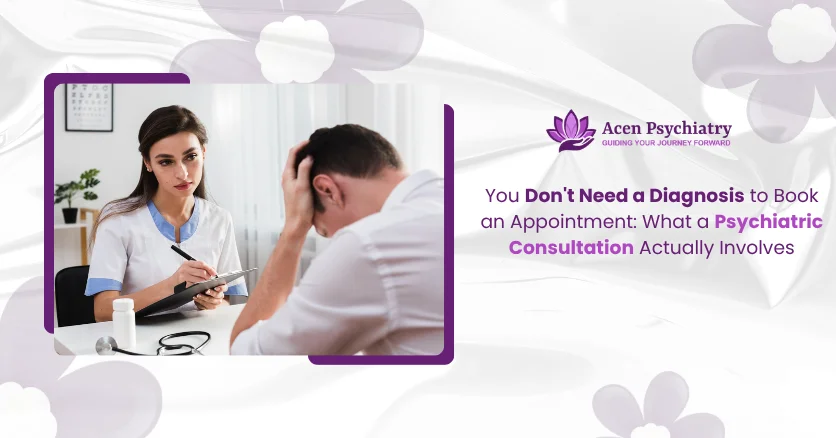
Think of an initial psychiatric consultation less like a final exam you need to study for, and more like a detailed,
structured conversation designed to map out what’s going on. Your provider will ask about:
- What you’ve been noticing — mood, energy, sleep, concentration, anything that feels different from your baseline
- How long it’s been going on, and whether anything seems to have triggered or worsened it
- How it’s affecting your daily life — work, relationships, sleep, physical health
- Your personal and family history
- Anything else relevant to the full picture, including physical health, medications, and substance use
From there, your provider does the work of identifying patterns, ruling things in or out, and determining what’s actually
going on — which may turn out to be a specific diagnosis, a combination of factors, or something that needs further
monitoring before a clear picture emerges. None of that requires you to have pre-diagnosed yourself.
Why Waiting for Certainty Often Backfires
It’s understandable to want clarity before seeking help, but waiting until you’re sure what’s wrong often means waiting
much longer than necessary — sometimes years. Symptoms can also be genuinely hard to self-diagnose accurately:
anxiety and depression frequently overlap, ADHD can look like anxiety, and many conditions share overlapping
symptoms that are difficult to tell apart without professional evaluation. Self-diagnosis, while a reasonable starting
point for noticing something is wrong, isn’t a substitute for an actual evaluation, and waiting for self-certainty before
seeking help can delay getting care that would have helped much sooner.
“I Don’t Even Know What I’d Say” Is a Fine Place to Start
If you’re worried about not having the right words, that’s genuinely okay. A skilled provider will ask the right questions
to help draw out what’s going on, even if you walk in only able to say “I just know something feels off.” You don’t need a
script, a self-diagnosis, or a tidy explanation. You just need to show up and be honest about what you’re experiencing.
Taking the First Step
If something has felt off — whatever shape that takes for you — that’s reason enough to schedule an evaluation. You
don’t need permission, a name for it, or certainty about what you’re walking into. That’s exactly what the consultation is
there to help you figure out.
Acen Integrative Psychiatric Services offers psychiatric consultations for patients ages 6 to 64 via telehealth across
California, Oregon, and Illinois, with in-person visits available by request. You’re welcome to come as you are, without a
diagnosis already in hand.
Ready to find out what’s actually going on? Book an appointment or contact us with any questions.
This article is for educational purposes and is not a substitute for a clinical evaluation. If you are in crisis or having thoughts of suicide, please call or text 988, or go to your nearest emergency room