
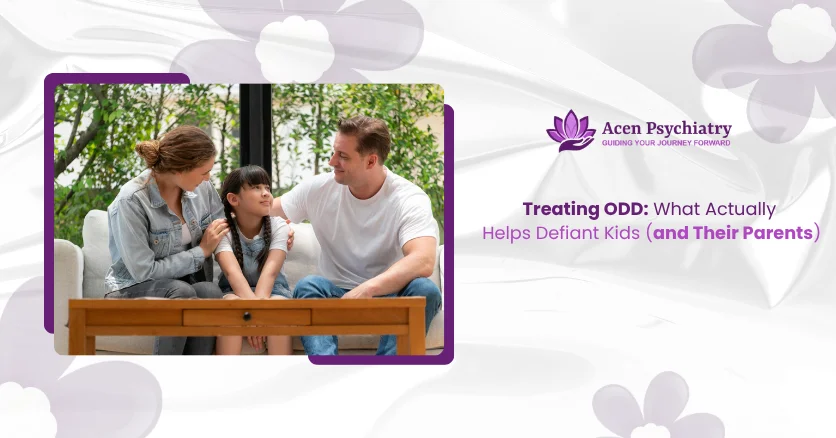
Treating ODD What Actually Helps Defiant Kids (and Their Parents)

Treating ODD: What Actually Helps Defiant Kids (and TheirParents)

If your child has been diagnosed with Oppositional Defiant Disorder, or you strongly suspect it, the next question is
what to actually do differently. The encouraging news: ODD has well-researched treatment approaches, and they tend
to work — but they often look different from what intuition or generic parenting advice suggests, which is part of why
so many families feel stuck before getting the right kind of support.

Parent Management Training: The Foundation

For most children with ODD, the single most effective intervention isn’t therapy with the child alone — it’s structured
parent training. This might seem counterintuitive, but the evidence is consistent: teaching parents specific, research
based strategies for responding to oppositional behavior produces better outcomes than working with the child in
isolation.

Effective parent management training typically covers:

Reducing power struggles. Many interactions with an oppositional child accidentally turn into a battle for control.
Specific strategies help parents give effective instructions, pick fewer but more important battles, and avoid escalating
exchanges that reinforce the defiance cycle.

Strategic attention and praise. Consistently and specifically praising desired behavior, even small instances of
cooperation, helps shift the pattern over time — many parents are unintentionally giving the most attention to the
negative behavior, since that’s what demands a response in the moment.

Consistent, predictable consequences. Consequences that are planned in advance, applied calmly, and consistent
across situations tend to work far better than reactive, emotionally-charged responses in the heat of the moment, which
can inadvertently escalate conflict.

Effective communication strategies. How a request is phrased — calm, direct, and specific rather than vague or
delivered as a question — significantly affects whether a child with ODD complies or escalates.

This isn’t about parents doing something wrong that needs fixing. ODD-specific strategies are different from general
parenting approaches precisely because oppositional kids respond differently to typical methods — what works for most
children can actually reinforce the cycle in a child with ODD.

Therapy Approaches With Evidence

Parent-Child Interaction Therapy (PCIT) is specifically designed for younger children and involves real-time
coaching of parents during interactions with their child, building both connection and effective behavior management
skills simultaneously.

Collaborative Problem Solving focuses on identifying the specific skills a child is lacking (such as flexibility or
frustration tolerance) and working collaboratively, rather than through punishment alone, to build those skills.

Individual therapy for the child can help, particularly for older children and teens, focusing on emotional regulation,
problem-solving skills, and addressing any co-occurring anxiety, depression, or trauma that may be contributing to the
behavior.

Addressing What’s Underneath

Because ODD so frequently overlaps with ADHD, anxiety, learning differences, or other conditions, treatment often
needs to address more than the oppositional behavior itself. If undiagnosed ADHD is driving chronic frustration,
treating the ADHD often reduces the oppositional behavior significantly, sometimes more than behavior-focused
interventions alone. This is why a comprehensive evaluation upfront matters so much for building an effective plan.

Is Medication Ever Part of Treatment?

There’s no medication specifically approved to treat ODD itself. However, medication may be appropriate when there’s
a co-occurring condition — most commonly ADHD — that’s contributing significantly to the oppositional behavior. In
these cases, treating the underlying condition is often a meaningful part of an overall plan that also includes parent
training and behavioral strategies.

What Progress Actually Looks Like

Improvement with ODD treatment tends to be gradual, not immediate. Encouraging signs include fewer and shorter
outbursts, faster recovery after conflict, more instances of cooperation (even if inconsistent at first), and a reduction in
the intensity of power struggles, even if some friction remains. Consistency from caregivers over weeks and months —
not a single perfect intervention — is what drives lasting change.

A Note for Exhausted Parents

If you’ve been white-knuckling through daily battles with your child, please know that this is genuinely hard, and
seeking help is not a last resort for failed parents — it’s a proactive step that gives both you and your child better tools.
With the right support, the relationship between you and your child can genuinely improve, not just become more
tolerable.

Acen Integrative Psychiatric Services provides evaluation and treatment for ODD and related behavioral concerns,
including coordination with parent training and behavioral therapy, for children and adolescents across California,
Oregon, and Illinois via telehealth, with in-person visits available by request.

Ready for a different approach? Book an appointment or contact us — we’re glad to help you build a plan that
actually fits your family.

This article is for educational purposes and is not a substitute for a clinical evaluation. If you have concerns about your child’s behavior or development, please consult a licensed provider
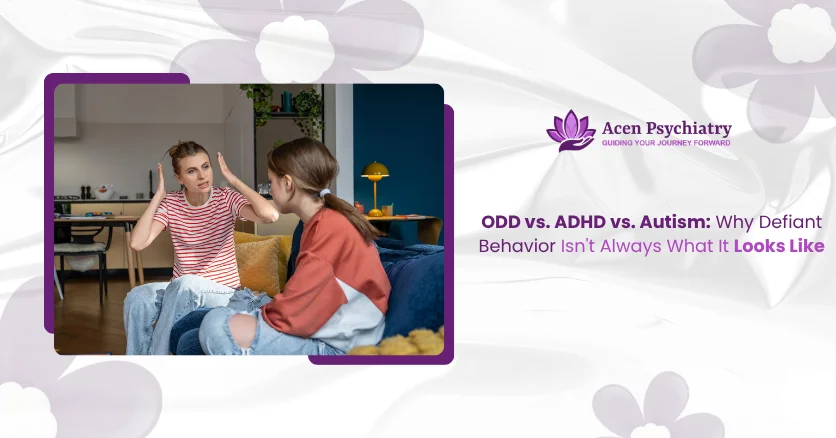
ODD vs  ADHD vs  Autism Why Defiant Behavior Isn't Always What It Looks Like

ODD vs. ADHD vs. Autism: Why Defiant Behavior Isn’t AlwaysWhat It Looks Like

If you’ve searched for help with a defiant, explosive, or seemingly noncompliant child, you’ve probably noticed that
ODD, ADHD, and autism all get mentioned in the same breath — sometimes because they overlap, and sometimes
because what looks like defiance is actually something else entirely being misread. Untangling which one (or which
combination) is actually driving your child’s behavior matters enormously, because the right intervention depends on
getting this right.

Why These Get Confused

On the surface, a child melting down when asked to stop a video game, refusing to follow instructions, or arguing about
every request can look identical regardless of the underlying cause. But the reason behind the behavior is often very
different — and that reason changes what actually helps.

ODD: Defiance Rooted in Emotional Reactivity and Power

In ODD, the core pattern is anger, argumentativeness, and active defiance, often with an element of wanting control or
pushing back against authority. A child with ODD typically:
Understands the request or rule but actively chooses to resist or argue
Often seems to be testing limits or asserting control in the interaction
Shows vindictiveness or deliberate annoyance at times
May behave very differently depending on who’s asking and what the stakes feel like

ADHD: “Defiance” That’s Actually Difficulty Complying

A child with ADHD may look defiant — ignoring instructions, not finishing tasks, seeming to “tune out” requests — but
the underlying driver is different. It’s often:
Genuine difficulty sustaining attention long enough to register or follow through on the instruction
Impulsivity that leads to reacting before fully processing what was asked
Difficulty with working memory, meaning the instruction was genuinely forgotten, not ignored
Frustration tolerance that’s lower due to ADHD itself, leading to outbursts that look oppositional but stem from a
different root
Importantly, ODD and ADHD frequently co-occur — a significant percentage of children with ODD also have ADHD,
and untreated ADHD can actually worsen oppositional behavior, since chronic frustration from unaddressed attention
difficulties feeds into anger and defiance over time.

Autism: Behavior That’s Actually About Overwhelm, Not Defiance

For autistic children, behavior that looks oppositional is often something else: a response to sensory overwhelm,
difficulty with unexpected changes or transitions, communication differences that make a request genuinely confusing,
or a need for routine and predictability being disrupted. A few things that distinguish this pattern:

  • The “defiance” often clusters around specific triggers — transitions, sensory input, changes in routine — rather than
    being generalized
  • There may be significant relief or calm once the triggering demand is removed, rather than escalating vindictiveness
    Communication differences may mean the child didn’t fully understand the request, rather than understanding and
    refusing it
  • Meltdowns often look different from the targeted, interaction-focused defiance seen in ODD — more like overwhelm
    than opposition
  • Autistic children can also have co-occurring ODD or ADHD, which is part of why a careful, comprehensive evaluation
    matters rather than assuming any single explanation.

Why This Distinction Actually Matters

The interventions that help each of these look quite different:

  • ODD responds well to structured parent management training, consistent consequences, and approaches that
    reduce power struggles while still holding clear limits.
  • ADHD responds to a combination of behavioral strategies, environmental accommodations, and often medication,
    targeting the attention and impulsivity driving the behavior.
  • Autism-related behavior responds to approaches that reduce sensory overwhelm, build predictability, support
    communication, and address the actual trigger rather than treating the behavior as willful defiance.

Using an ODD-focused approach (heavy emphasis on consequences and limit-setting) with a child whose real issue is
autism-related overwhelm can backfire badly, increasing distress rather than improving behavior. The reverse is also
true. This is exactly why getting an accurate diagnosis — not just a label that fits the most visible behavior — changes
the entire treatment approach.

Getting a Clear Picture

A comprehensive evaluation considers your child’s full developmental history, behavior across multiple settings, input
from teachers and caregivers, and careful attention to what’s actually triggering and following the behavior, not just the
behavior itself. Many children have more than one of these conditions simultaneously, which means treatment
sometimes needs to address several things at once rather than picking just one diagnosis.

If you’ve tried generic parenting advice or one-size-fits-all behavior plans without success, it may be a sign that the
underlying driver hasn’t been correctly identified yet.

Acen Integrative Psychiatric Services provides comprehensive evaluation for ODD, ADHD, autism, and related
conditions in children and adolescents, via telehealth across California, Oregon, and Illinois, with in-person visits
available by request.

Trying to figure out what’s actually going on? Book an appointment or contact us — we’re glad to help you get
a clear answer.

This article is for educational purposes and is not a substitute for a clinical evaluation. If you have concerns about your child’s behavior or development, please consult a licensed provider

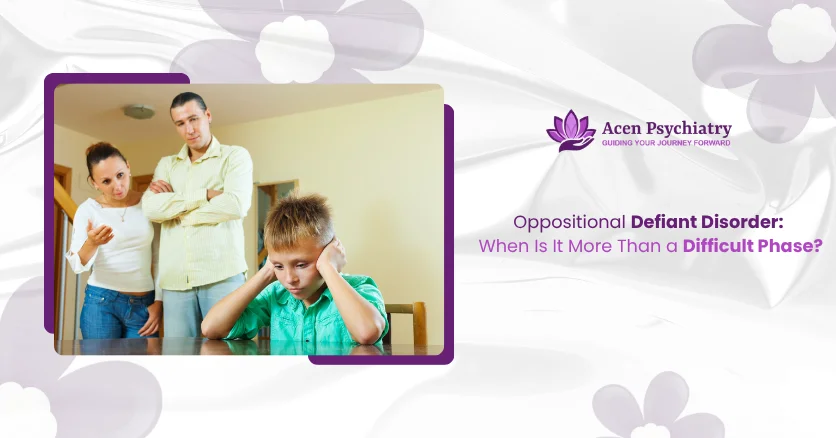
Oppositional Defiant Disorder When Is It More Than a Difficult Phase

Oppositional Defiant Disorder: When Is It More Than a DifficultPhase?

Every child argues, pushes back, and tests limits sometimes — it’s a normal part of development, especially during
certain ages and transitions. But for some children, defiance, anger, and conflict with authority figures become the
dominant pattern, persisting well beyond what’s typical and significantly disrupting family life, school, and friendships.
When that happens, it may be Oppositional Defiant Disorder, a recognized and treatable condition — not simply a
parenting failure or a “bad kid.”

What ODD Actually Looks Like

Oppositional Defiant Disorder involves a persistent pattern, lasting at least six months, of:

Angry and irritable mood, including frequently losing their temper, being easily annoyed, and seeming chronically
angry or resentful.

Argumentative and defiant behavior, including arguing with adults, actively defying or refusing to comply with rules
and requests, deliberately annoying others, and blaming others for their own mistakes or misbehavior.

Vindictiveness, including spitefulness or seeking revenge at least a couple of times in the past six months.

Importantly, these behaviors need to occur across more than one setting (not just with one parent, or only at home, or
only at school) and need to be more frequent and intense than what’s typical for the child’s age and developmental
stage.

How This Is Different From Typical Childhood Pushback

Nearly every toddler has tantrums. Nearly every teenager argues with their parents. The question with ODD isn’t
whether a child ever pushes back — it’s whether the pattern is persistent, pervasive, and disproportionate.

A few distinguishing questions:

  • Is the defiance happening almost daily, rather than occasionally during expected developmental friction?
  • Is it showing up across multiple relationships and settings, not just with one specific person or in one specific
    context?
  • Has it lasted six months or more, rather than being tied to a recent, specific stressor that should resolve?
  • Is it significantly disrupting family functioning, friendships, or school, beyond ordinary parent-child conflict?

A child who’s difficult with one strict teacher but fine everywhere else is showing something different from a child
whose anger and defiance show up with parents, teachers, coaches, and peers alike.

What’s Actually Going On Underneath

It’s easy to see oppositional behavior and assume the child is simply choosing to be difficult. In reality, ODD often
reflects underlying difficulties with emotional regulation — these are often children who feel emotions, especially
frustration and perceived injustice, more intensely than their peers, and who haven’t yet developed the skills to manage
and express that intensity in more flexible ways.

Contributing factors can include:

  • Difficulty with emotional regulation and frustration tolerance
  • Co-occurring ADHD (very common alongside ODD)
  • Family stress, inconsistency in discipline, or significant life disruptions
  • Learning differences that create chronic frustration, particularly at school
  • A temperament that’s naturally more intense or reactive

None of this means a child “can’t help it” in a way that removes the need for structure and consequences — but it does
mean the most effective interventions focus on building skills, not just imposing punishment.

Why Getting an Accurate Picture Matters

ODD frequently overlaps with other conditions, and behavior that looks oppositional on the surface sometimes has a
different underlying driver entirely — undiagnosed ADHD, anxiety, a learning disability, or even depression in some
children, which can present as irritability rather than sadness. A careful evaluation looks at the whole picture rather
than assuming the most visible behavior is the whole story.

You’re Not Failing as a Parent

If you’re living with a child who seems to fight you on everything, it’s exhausting, and it’s easy to internalize that as a
parenting failure. It usually isn’t. ODD responds well to the right kind of structured support — both for the child and for
the parents navigating it day to day. Getting an evaluation isn’t giving up or labeling your child; it’s the first step toward
something that actually works better than what you’ve likely already tried.

Acen Integrative Psychiatric Services provides evaluation and treatment for ODD and related behavioral concerns in
children and adolescents, via telehealth across California, Oregon, and Illinois, with in-person visits available by
request.

Want to talk through what you’re seeing at home? Book an appointment or contact us — we’re glad to help you
figure out the next step.

This article is for educational purposes and is not a substitute for a clinical evaluation. If you have concerns about your child’s behavior or development, please consult a licensed provider.