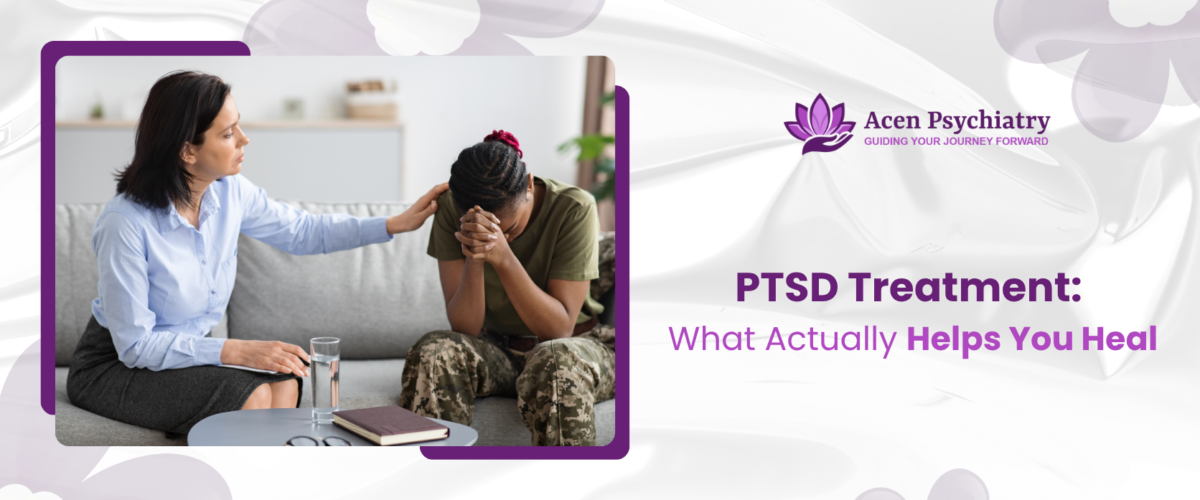
PTSD Treatment What Actually Helps You Heal (1)

PTSD Treatment: What Actually Helps You Heal

If you’ve recognized PTSD in yourself or started to understand what you’ve been experiencing, the next question is what treatment actually looks like. PTSD is one of the more researched conditions in mental health, and the evidence behind certain treatments is strong. Here’s an honest look at what tends to help.

Trauma-Focused Therapy

Unlike general talk therapy, trauma-focused therapies are specifically structured to help process traumatic memories rather than just discuss them. The strongest evidence-based options include:

  • Cognitive Processing Therapy (CPT) helps identify and shift unhelpful beliefs that developed because of the trauma — things like excessive self-blame, beliefs about safety, or trust — through structured cognitive work.
  • Prolonged Exposure (PE) Therapy involves gradually and safely approaching trauma-related memories and situations that have been avoided, which over time reduces their power to trigger distress. This is one of the most extensively researched PTSD treatments.
  • Eye Movement Desensitization and Reprocessing (EMDR) uses guided eye movements while processing traumatic memories, based on the idea that this helps the brain reprocess “stuck” memories. EMDR has a strong evidence base, particularly for single-incident trauma.
  • Trauma-Focused CBT (TF-CBT) is specifically designed for children and adolescents, combining trauma processing with skills for managing emotions and involving caregivers in the treatment process.

These therapies typically require a structured course of sessions — often 8 to 16, depending on the approach — rather than open-ended, indefinite talk therapy. They can feel difficult, particularly in the early sessions, but that difficulty is part of the process of reducing the trauma’s grip over time, not a sign that something is going wrong.

Medication

Medication doesn’t “cure” PTSD, but it can meaningfully reduce symptoms and make it more possible to engage in therapy.

  • SSRIs and SNRIs are the primary medication options with evidence for PTSD, and they can help with the depression, anxiety, and hyperarousal symptoms that often accompany it.
  • Prazosin is sometimes used specifically for PTSD-related nightmares, targeting that symptom more directly than general antidepressants do.

Medication is often most helpful as a complement to trauma-focused therapy rather than a replacement for it — symptom relief from medication can make someone more able to engage with and benefit from therapy, rather than being too overwhelmed to do the deeper work.

Why Trauma-Focused Treatment Matters Specifically

General supportive therapy — just talking about how you’re feeling — can be valuable for overall wellbeing, but it isn’t the same as trauma-focused treatment, and it isn’t enough on its own to resolve PTSD for most people. The structured, evidence-based therapies listed above are specifically designed to help the brain process traumatic memories differently, not just talk around them. If you’ve been in therapy for PTSD without much improvement, it may be worth asking whether the approach being used is one of the trauma-specific modalities above.

What to Expect From the Process

Healing from trauma isn’t linear. Some honest things to know going in:

  • It’s common to feel worse before feeling better in the early stages of trauma-focused therapy, as you begin engaging with memories you’ve been avoiding.
  • Progress isn’t always steady — setbacks, particularly around anniversaries or reminders, don’t mean treatment isn’t working.
  • You’re in control of the pace. Good trauma treatment never forces you faster than you’re ready to go, and a skilled provider will check in regularly about pacing.
  • Improvement is measurable, not just a feeling. Reduced flashback frequency, better sleep, less avoidance, and an easier time engaging with daily life are real, trackable signs of progress.

You Don’t Have to Carry This Alone

If you’ve been managing PTSD symptoms on your own — through avoidance, overwork, or simply white-knuckling through daily life — know that real, structured treatment exists and works. You don’t have to keep organizing your life around what happened.

Acen Integrative Psychiatric Services offers PTSD treatment, including medication management and coordination with trauma-focused therapy, for patients ages 6 to 64 across California, Oregon, and Illinois via telehealth, with in-person visits available by request.

Ready to explore what could help? Book an appointment or contact us — we’re glad to talk through your options.

This article is for educational purposes and is not a substitute for a clinical evaluation. If you are in crisis or having thoughts of suicide, please call or text 988, or go to your nearest emergency room.
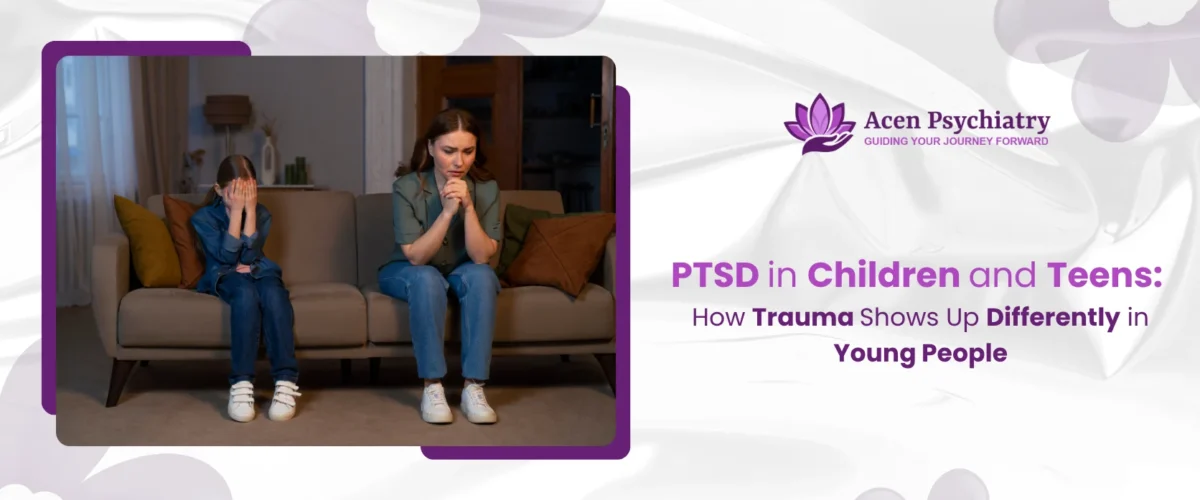
PTSD in Children and Teens How Trauma Shows Up Differently in Young People (1)

PTSD in Children and Teens: How Trauma Shows Up Differently in Young People

When we picture PTSD, we tend to picture adults. But children and teens can develop PTSD too, after experiences like accidents, abuse, neglect, witnessing violence, a frightening medical event, or the sudden loss of a parent or caregiver. The challenge for parents is that PTSD in young people often doesn’t look like the textbook adult version — which means it can go unrecognized for a long time, sometimes mistaken for behavioral problems, anxiety, or simply “acting out.”

How Trauma Symptoms Differ by Age

Young children (under 6) often can’t verbalize what they’re experiencing. Trauma may show up as:

  • Regression in skills they’d already mastered (potty training, language)
  • Clinginess and separation anxiety beyond what’s typical for their age
  • Re-enacting the traumatic event through play, sometimes repetitively
  • New or worsened nightmares, not necessarily about the event directly
  • Physical symptoms like stomachaches with no medical explanation

School-age children may show:

  • A drop in school performance or difficulty concentrating
  • Increased irritability, anger outbursts, or aggressive behavior
  • Avoidance of specific people, places, or situations connected to the trauma
  • Trouble sleeping, nightmares, or new fears that weren’t present before
  • Physical complaints (headaches, stomachaches) without clear medical cause
  • Guilt or self-blame about the traumatic event, even when it wasn’t their fault

Teenagers often present closer to the adult pattern, but with some distinct features:

  • Risk-taking behavior, including substance use, that wasn’t present before
  • Withdrawal from friends and previously enjoyed activities
  • Irritability, anger, or a noticeable shift in personality
  • Difficulty trusting others or significant relationship changes
  • Self-destructive behavior in some cases
  • Avoidance of reminders, sometimes including refusing to discuss the event at all

Why Trauma in Kids Gets Misread

A child or teen showing trauma symptoms is frequently labeled as having a behavior problem, ADHD, or “just being difficult,” especially when the trauma itself isn’t known or disclosed. A few reasons this happens:

  • Kids may not disclose what happened, especially if the trauma involved someone they depend on, if they feel shame or responsibility, or if they don’t have the words to describe it.
  • Acting out can look like the problem itself, rather than a symptom of something underneath. A child having angry outbursts may be treated for “behavior issues” without anyone asking what might be driving that anger.
  • Adults sometimes assume kids are resilient and will “bounce back,” which can lead to underestimating how seriously an event affected a child, particularly when the child seemed okay immediately afterward.

What Parents Can Do

If you know your child experienced a frightening or traumatic event, watch for symptoms that persist beyond a few weeks, especially if they’re intensifying rather than improving. Some things that can help in the meantime:

  • Maintain normal routines as much as possible — predictability is stabilizing for kids after trauma
  • Let your child guide how much they want to talk about what happened, without forcing it
  • Avoid minimizing (“it wasn’t that bad”) or over-dramatizing the event in front of them
  • Watch your own reactions — kids take cues from how calm or distressed the adults around them are
  • Seek professional support sooner rather than later if symptoms aren’t improving

What an Evaluation Involves

A thorough evaluation for childhood or adolescent PTSD includes a conversation with parents about the child’s history and observed symptoms, age-appropriate engagement with the child or teen directly, and often input from teachers or other caregivers. Because trauma symptoms overlap significantly with ADHD, anxiety, and depression, a careful evaluation considers the full picture rather than assuming the most obvious label.

Treatment Works, and Earlier Is Better

Trauma-focused therapies designed specifically for children and teens — including Trauma-Focused CBT — have strong evidence for helping young people process traumatic experiences and reduce symptoms. The earlier trauma is addressed, the better the outcomes tend to be, but it’s never too late to get help, even years after the event.

Acen Integrative Psychiatric Services provides PTSD and trauma-related evaluation and treatment for children and adolescents via telehealth across California, Oregon, and Illinois, with in-person visits available by request.

Concerned about your child or teen? Book an appointment or contact us — we’re glad to help you figure out the next step.

This article is for educational purposes and is not a substitute for a clinical evaluation. If you have concerns about your child’s wellbeing or safety, please consult a licensed provider.

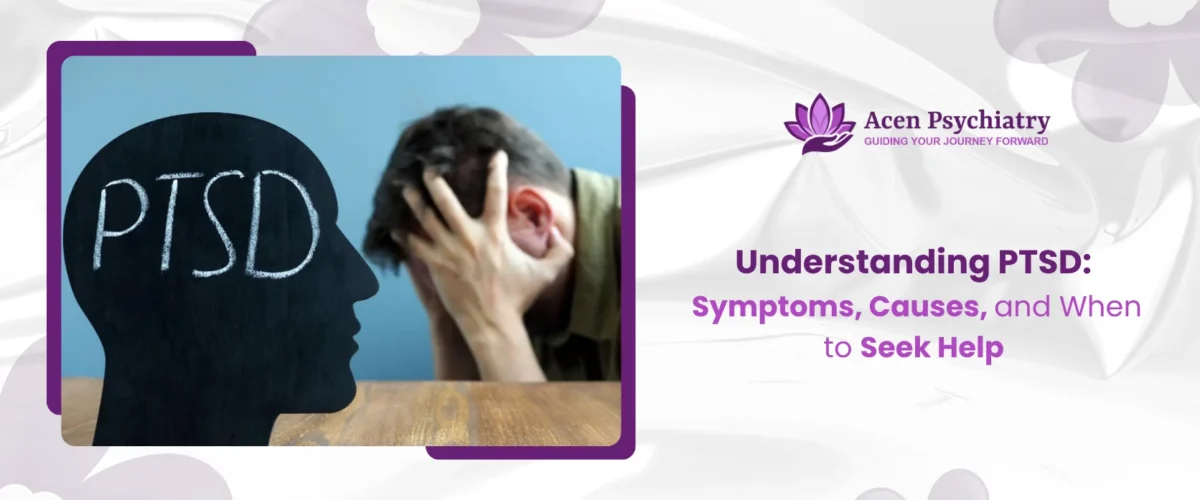
Copy of Understanding PTSD Symptoms, Causes, and When to Seek Help (1)

Understanding PTSD: Symptoms, Causes, and When to Seek Help

Most people associate PTSD with combat veterans, but post-traumatic stress disorder can develop after any event that overwhelms a person’s ability to cope — an accident, an assault, a medical crisis, the sudden loss of someone close, or witnessing violence. Not everyone who experiences trauma develops PTSD, and that’s not a reflection of strength or weakness. It’s about how the brain and body process an overwhelming experience, and for some people, that processing gets stuck.

What PTSD Actually Looks Like

PTSD symptoms generally fall into four categories, and a diagnosis typically requires symptoms from each one, persisting for more than a month and causing real disruption to daily life.
Intrusive memories. Unwanted, distressing memories of the traumatic event, flashbacks that feel like reliving it, nightmares, or intense distress when something reminds you of what happened.
Avoidance. Steering clear of places, people, conversations, or activities that bring back memories of the trauma — sometimes in obvious ways, sometimes through subtle daily choices that quietly shrink a person’s world.
Negative changes in thinking and mood. Persistent negative beliefs about yourself or the world (“I’m not safe anywhere,” “I can’t trust anyone”), emotional numbness, loss of interest in things you used to enjoy, difficulty feeling positive emotions, or memory gaps around the event itself.
Changes in arousal and reactivity. Being easily startled, feeling constantly on guard, irritability or angry outbursts, difficulty sleeping or concentrating, and a heightened startle response that wasn’t there before.

Trauma Doesn’t Have to Look a Certain Way

One of the most common misconceptions about PTSD is that it only follows dramatic, life-threatening events. In reality, PTSD can develop after:
Car accidents or other serious accidents
Physical or sexual assault
Childhood abuse or neglect
Witnessing violence, even if you weren’t directly harmed
A frightening medical diagnosis or traumatic medical procedure
The sudden or violent death of someone close to you
Natural disasters
Prolonged exposure to a dangerous or unstable environment
What determines whether trauma leads to PTSD isn’t just the event itself, but a combination of factors — how overwhelming the experience was, the support available afterward, prior history of trauma, and individual biological factors that are still being researched. None of this is something a person chooses or controls.

Why It’s Often Missed

PTSD frequently goes unrecognized, for a few reasons:
Symptoms can be mistaken for other conditions. Irritability, sleep problems, and difficulty concentrating overlap heavily with depression and anxiety, and a PTSD diagnosis can be missed if a provider doesn’t specifically ask about trauma history.
Delayed onset is real. Symptoms don’t always appear immediately after a traumatic event. Sometimes they emerge months or even years later, often triggered by a new stressor or reminder.
Avoidance makes it invisible. Because avoidance is a core symptom, many people with PTSD become very good at steering around anything that would reveal the problem — including conversations about the trauma itself.
Shame and self-blame keep people quiet. Especially after assault or abuse, many people carry unwarranted guilt that keeps them from seeking help, even though the trauma was never their fault.

When to Seek Help

If it’s been more than a month since a traumatic event and you’re still experiencing intrusive memories, avoidance, mood changes, or heightened reactivity that’s interfering with your daily life, it’s time to talk to a professional. You don’t need to have processed or “made sense of” what happened before seeking help — that’s part of what treatment is for.
If you are having thoughts of suicide or self-harm, please reach out immediately. Call or text 988 (the Suicide & Crisis Lifeline) any time, or go to your nearest emergency room.

Healing Is Possible

PTSD is treatable, and most people who receive appropriate treatment see meaningful improvement. You don’t have to keep living life around the trauma — there are evidence-based paths through it.
Acen Integrative Psychiatric Services provides PTSD evaluation and treatment for patients ages 6 to 64, via telehealth across California, Oregon, and Illinois, with in-person visits available by request.
Ready to take the first step? Book an appointment or contact us with any questions.
This article is for educational purposes and is not a substitute for a clinical evaluation. If you are in crisis or having thoughts of suicide, please call or text 988, or go to your nearest emergency room.
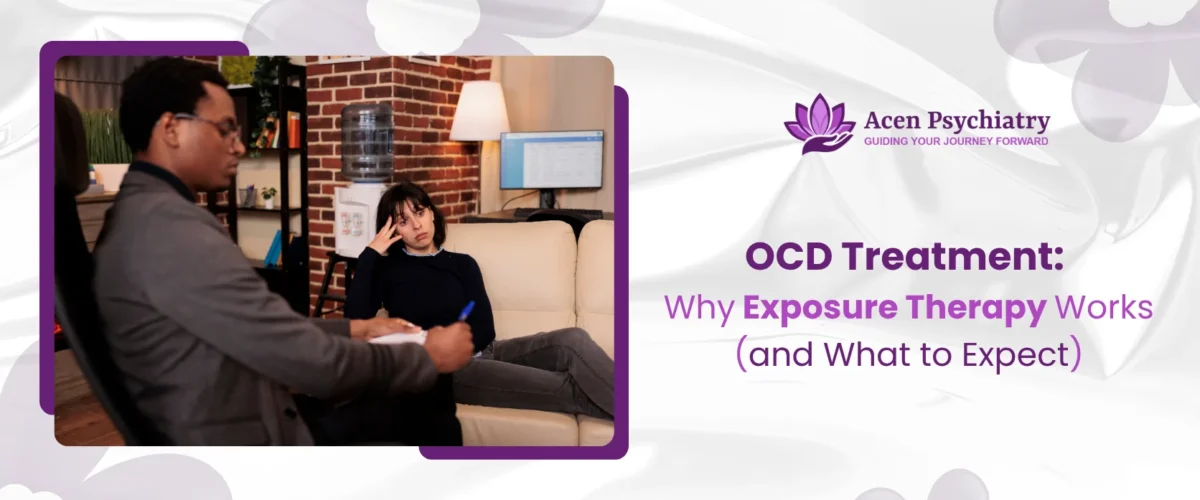
OCD Treatment Why Exposure Therapy Works (and What to Expect) (1)

OCD Treatment: Why Exposure Therapy Works (and What to Expect)

If you’ve started researching OCD treatment, you’ve likely come across Exposure and Response Prevention, or ERP, described as the gold-standard treatment. You may have also felt a flicker of dread reading about it — the idea of deliberately facing the exact thoughts or situations that trigger your anxiety can sound counterintuitive at best, and frightening at worst. Understanding why this approach works, and what it actually involves, can make it feel far more approachable than it might sound at first.

Why Standard Talk Therapy Often Doesn’t Help OCD Much

General talk therapy — discussing feelings, exploring underlying causes, building insight — is valuable for many conditions, but it tends to be far less effective for OCD specifically. This is because OCD isn’t primarily a thinking problem to reason through; it’s a learned response pattern between an intrusive thought, anxiety, and a compulsion that relieves it. Talking about the anxiety doesn’t interrupt that cycle. A treatment that directly targets the cycle does.

How Exposure and Response Prevention Actually Works

ERP is built on a straightforward but powerful principle: anxiety naturally decreases on its own if you don’t perform the compulsion, even though it feels at the moment like it never will.
The process typically involves:
Building a hierarchy. You and your therapist identify your specific obsessions and compulsions, then rank feared situations from least to most distressing.
Gradual exposure. Starting with manageable situations, you deliberately face the trigger — a feared thought, situation, or sensation — without performing the usual compulsion.
Response prevention. This is the critical part: resisting the urge to perform the ritual that would normally relieve the anxiety, even though the urge to do so feels intense.
Tolerating the anxiety. Rather than escaping the discomfort, you stay with it, and your therapist helps you notice that the anxiety peaks and then naturally declines on its own, even without the compulsion — proving to your brain, through direct experience rather than just being told, that the feared outcome doesn’t require the ritual to prevent it.
Over repeated practice, both the intensity and duration of the anxiety response decrease, and the compulsive urge weakens significantly.

A Few Things That Make ERP Feel Less Intimidating

You’re never thrown into your worst fear first. ERP is built gradually, starting with exposures that are challenging but manageable, building tolerance before moving to more difficult ones. A skilled therapist paces this collaboratively with you, not for you.
You’re in control of the pace. While ERP does require leaning into discomfort rather than avoiding it, you and your therapist decide together how quickly to progress, and it’s normal for that pace to be slower at times than others.
The anxiety is temporary, even when it doesn’t feel that way in the moment. One of the most validating parts of ERP for many people is directly experiencing, again and again, that the dreaded anxiety does come down on its own — something that’s hard to believe in the abstract but becomes increasingly clear through repeated direct experience.
It works on mental compulsions too, not just visible behaviors like handwashing — ERP can be adapted for reassurance-seeking, mental reviewing, and other internal compulsions that aren’t observable from the outside.

Medication’s Role

SSRIs, often at higher doses than typically used for depression, are the primary medication option with strong evidence for OCD. Medication can meaningfully reduce the intensity of obsessions and compulsions, which for some people makes it more possible to engage fully in ERP.
Many people benefit from combining medication with ERP, particularly for more severe OCD, though some people do well with ERP alone, especially for milder presentations.

What Progress Actually Looks Like

Improvement with ERP tends to be gradual rather than immediate, and it’s genuinely common to feel like things are getting harder before they get easier, particularly in the early stages of facing avoided situations directly. Encouraging signs of progress include a shorter, less intense anxiety response to triggers, reduced time spent on compulsions, and a growing ability to tolerate uncertainty without needing to resolve it through ritual.

You Don’t Have to Live Around the Rituals Forever

If OCD has been quietly shaping your daily life — the time it takes, the situations you avoid, the reassurance you constantly seek — know that effective, well-studied treatment exists, and significant improvement is genuinely achievable, not just modest symptom management.
Acen Integrative Psychiatric Services offers OCD treatment, including medication management and coordination with ERP-trained therapists, for patients ages 6 to 64 across California, Oregon, and Illinois via telehealth, with in-person visits available by request.
Ready to talk through what treatment could look like for you? Book an appointment or contact us — we’re glad to help you take the next step.
This article is for educational purposes and is not a substitute for a clinical evaluation. If you’re experiencing distressing intrusive thoughts or compulsions, please consider speaking with a licensed provider.

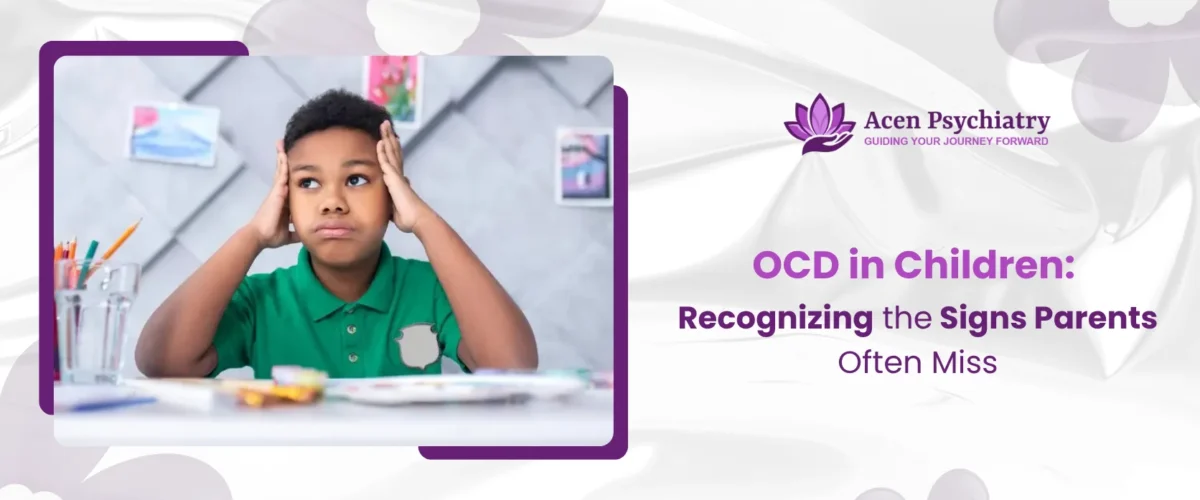
OCD in Children Recognizing the Signs Parents Often Miss

OCD in Children: Recognizing the Signs Parents Often Miss

When a child repeats the same action over and over, asks the same question repeatedly despite already knowing the answer, or has a meltdown when a routine is disrupted, it’s easy to chalk it up to a phase, quirky personality, or just being a kid. Sometimes that’s exactly what it is. But for some children, these patterns are early signs of Obsessive Compulsive Disorder — a condition that can begin as young as preschool age and is frequently missed because it doesn’t look the way most parents expect.

How OCD Shows Up in Kids

Because young children often can’t articulate intrusive thoughts the way an adult can, OCD in children is usually first noticed through behavior rather than reported thoughts:

  • Repeating actions a specific number of times, or until it “feels right”
  • Excessive handwashing, or avoidance of things perceived as dirty or contaminated
  • Needing objects arranged in a particular way, with significant distress if disrupted
  • Repeatedly asking the same reassurance-seeking questions (“Are you sure nothing bad will happen?”) despite already having been answered
  • Checking behaviors — repeatedly checking that a door is locked, a backpack is packed correctly, or homework is done right
  • Avoiding certain numbers, words, or specific routines tied to an irrational fear
  • Taking an unusually long time to complete simple tasks like getting dressed or finishing homework, due to rituals embedded in the process
  • Seeking excessive reassurance about harm coming to themselves or people they love
  • Visible distress, tantrums, or meltdowns specifically when a ritual is interrupted or can’t be completed

What Makes This Different From Typical Childhood Behavior

Many children go through phases involving rituals, repetition, or specific preferences — wanting the same bedtime routine every night, lining up toys precisely, or having particular rules about how things should be done. The line between typical childhood behavior and OCD comes down to distress and function:

  • Is the behavior driven by genuine anxiety or dread, rather than simple preference or enjoyment?
  • Does interrupting the behavior cause significant distress, well beyond ordinary frustration?
  • Is it consuming significant time — an hour or more a day in many cases — or significantly disrupting daily routines like getting to school on time?
  • Is it expanding over time to cover new situations, rather than staying contained to one specific context?
    A child who likes lining up toys but is fine if the arrangement gets disrupted is different from a child who becomes intensely distressed and must redo the arrangement before being able to move on to anything else.

A Specific Pattern Worth Knowing: PANDAS/PANS

In rare cases, OCD symptoms in children can appear suddenly and dramatically — virtually overnight — sometimes following a strep infection or other illness. This is associated with a condition called PANDAS (Pediatric Autoimmune Neuropsychiatric Disorder Associated with Streptococcal infections) or the broader category PANS (Pediatric Acute onset Neuropsychiatric Syndrome). If your child develops sudden, severe OCD symptoms seemingly overnight, particularly following an illness, this is worth specifically raising with your child’s evaluating provider, as it may point toward a different underlying process requiring a distinct treatment approach.

Why Parents Often Miss It

Kids may not have words for intrusive thoughts. Younger children especially may not be able to articulate “I have a thought that scares me,” and instead simply act out the compulsion without explaining why.
Reassurance-seeking can look like ordinary anxious-kid behavior. A child repeatedly asking “are you sure?” can seem like garden-variety childhood worry rather than a compulsive pattern, especially if parents are giving the reassurance the child seems to want.
Compliance with rituals by parents can mask the severity. Many families unknowingly accommodate a child’s compulsions — answering the same question repeatedly, adjusting routines around rituals — which can reduce visible distress while the underlying pattern continues to grow.
Shame, even in children, can keep symptoms hidden, particularly around taboo-themed or harm-related intrusive thoughts, which children may sense are “bad” to talk about even without fully understanding why.

What to Do If You Notice These Signs

If you’re noticing patterns that feel driven by distress rather than preference, and the behaviors are expanding, consuming significant time, or causing real disruption, it’s worth seeking an evaluation. Try to observe specifics — what triggers the behavior, how your child reacts if it’s interrupted, and any verbal clues about what’s driving it — since these details are genuinely helpful for an evaluating provider.

Treatment Works, Especially When Started Early

OCD in children responds very well to treatment, particularly Exposure and Response Prevention therapy (a specific, structured form of CBT designed for OCD), sometimes combined with medication for more significant symptoms. Early intervention tends to lead to better long-term outcomes, but treatment can help at any age.
Acen Integrative Psychiatric Services provides OCD evaluation and treatment for children and adolescents via telehealth across California, Oregon, and Illinois, with in-person visits available by request.
Noticing some of these patterns in your child? Book an appointment or contact us — we’re glad to help you figure out the next step.
This article is for educational purposes and is not a substitute for a clinical evaluation. If you have concerns about your child’s behavior or development, please consult a licensed provider.

OCD Is Not Just Liking Things Tidy What Obsessive Compulsive Disorder Actually Looks Like (1)

OCD Is Not Just Liking Things Tidy: What Obsessive-Compulsive Disorder Actually Looks Like

“I’m so OCD about my desk” is one of the most common, well-meaning misuses of a clinical term in everyday language. Real Obsessive-Compulsive Disorder has almost nothing to do with liking things neat or organized. It’s a disorder built around intrusive, distressing thoughts and the exhausting rituals people feel compelled to perform to manage the anxiety those thoughts create — and it can take forms that have nothing to do with cleanliness at all.

The Two Core Components

OCD has two defining parts, and understanding both is essential to understanding the condition.
Obsessions are intrusive, unwanted thoughts, images, or urges that cause significant distress and that a person can’t simply choose to stop having. Critically, these thoughts are unwanted — they don’t reflect what someone actually wants or believes, which is part of what makes them so distressing.
Compulsions are repetitive behaviors or mental acts performed to reduce the anxiety caused by the obsession, or to prevent some feared outcome. Compulsions provide short-term relief, which is exactly what reinforces and perpetuates the cycle over time.
The relationship between the two is the core of OCD: an intrusive thought creates intense anxiety, a compulsion temporarily relieves it, and the relief reinforces the urge to perform the compulsion again the next time the thought appears — a cycle that tends to grow more entrenched, not less, the longer it continues.

OCD Themes Go Far Beyond Cleanliness

Contamination fears and cleaning rituals are the most publicly recognized form of OCD, but they represent only one of many possible themes:

  • Contamination and cleaning — fear of germs, illness, or contamination, often involving excessive washing or cleaning rituals.
  • Symmetry and order — needing things arranged, counted, or aligned in a specific way, with significant distress if disrupted.
  • Checking — repeatedly checking locks, appliances, or that something wasn’t accidentally done wrong, often well beyond what the situation warrants.
  • Harm-related obsessions — intrusive, unwanted thoughts about accidentally or intentionally harming oneself or others, despite having no actual desire to cause harm. These thoughts are a known OCD presentation and do not reflect a person’s true intentions or character.
  • Relationship and “Am I sure?” obsessions — persistent doubt about relationships, sexual orientation, or identity, with compulsive mental reviewing or reassurance-seeking to try to resolve the uncertainty.
  • Religious or moral obsessions (scrupulosity) — intrusive fears about having sinned, been immoral, or offended a religious or moral standard, often with compulsive praying, confessing, or mental reviewing.
  • Health-related obsessions — persistent fear of having a serious illness despite medical reassurance, often involving repeated body-checking or researching symptoms.
    Many people with OCD experience compulsions that are entirely mental — repeating phrases internally, mentally reviewing events, or silently counting — which means OCD can be completely invisible to anyone observing from the outside.

Why “Just Liking Things a Certain Way” Misses the Point Entirely

The casual use of “OCD” to describe a preference for tidiness or organization misses what actually defines the disorder: significant distress, time consumption, and real interference with daily functioning. Someone who simply likes an organized desk feels satisfied by tidiness. Someone with OCD-related symmetry obsessions feels acute anxiety and distress until a ritual is completed — it’s relief from suffering, not a preference being satisfied.
A helpful distinguishing question: does this behavior bring you genuine satisfaction, or does it relieve dread? OCD is built on the latter.

Why OCD Often Goes Unrecognized for Years

OCD frequently goes undiagnosed for a long time, for a few specific reasons:
Shame keeps people quiet, especially around harm-related or taboo-themed obsessions. Many people with violent or disturbing intrusive thoughts are terrified to disclose them, fearing they’ll be judged or misunderstood, even though these thoughts are a well-recognized OCD presentation that says nothing about a person’s actual character or intentions.
Mental compulsions are invisible. Without observable rituals like handwashing, OCD built around mental reviewing, reassurance-seeking, or silent rituals can go completely unnoticed by others, and sometimes unrecognized by the person experiencing it as anything other than “overthinking.”
It overlaps with anxiety. OCD shares features with generalized anxiety, and without specifically screening for the obsession-compulsion cycle, it’s easy for a provider to treat general anxiety without identifying the OCD pattern underneath.

Getting an Accurate Evaluation

A thorough OCD evaluation specifically asks about intrusive thoughts across the full range of common themes, not just contamination, and explores both behavioral and mental compulsions. If you’ve experienced intrusive, unwanted thoughts that cause real distress, along with rituals or mental acts aimed at relieving that distress, it’s worth bringing this up directly and specifically, even if it feels uncomfortable or embarrassing to describe.
OCD is highly treatable, and effective, evidence-based treatment exists. You don’t have to keep managing this alone, and you don’t have to feel ashamed of thoughts you never wanted to have in the first place.
Acen Integrative Psychiatric Services provides comprehensive OCD evaluation and treatment for patients ages 6 to 64, via telehealth across California, Oregon, and Illinois, with in-person visits available by request.
Ready to get an accurate picture? Book an appointment or contact us with any questions.
This article is for educational purposes and is not a substitute for a clinical evaluation. If you’re experiencing distressing intrusive thoughts, please know this is a recognized, treatable condition, and consider speaking with a licensed provider

Postpartum Depression What New Parents Need to Know (1)

Postpartum Depression: What New Parents Need to Know

Bringing a new baby home is supposed to feel joyful — and for many parents, it also feels exhausting, disorienting, and harder than anyone warned them it would be. Somewhere in that mix, it can be genuinely difficult to tell the difference between normal new-parent adjustment and something that needs real support. Postpartum depression is common, treatable, and nothing to feel ashamed of, but it’s also frequently missed, both by new parents themselves and by the people around them.

The “Baby Blues” vs. Postpartum Depression

Up to 80% of new mothers experience the “baby blues” — mood swings, tearfulness, anxiety, and difficulty sleeping in the days after birth, driven largely by rapid hormonal shifts. This typically peaks within the first week and resolves on its own within about two weeks, without needing treatment. Postpartum depression is different. It tends to last longer than two weeks, feels more severe, and significantly interferes with your ability to function or care for yourself and your baby. If symptoms persist beyond two weeks, or feel intense from the start, it’s time to take it seriously rather than wait it out.

Signs of Postpartum Depression

Postpartum depression can show up anytime in the first year after birth, not just in the immediate newborn period. Signs include:

  • Persistent sadness, emptiness, or hopelessness
  • Severe mood swings or overwhelming irritability and anger
  • Difficulty bonding with your baby, or feeling disconnected from them
  • Withdrawing from your partner, family, or friends
  • Changes in appetite, eating much more or much less than usual
  • Inability to sleep even when the baby is sleeping, or sleeping far more than usual
  • Overwhelming fatigue or loss of energy
  • Intense anxiety, panic attacks, or racing, intrusive worries
  • Feelings of worthlessness, guilt, or being a “bad parent”
  • Difficulty concentrating or making decisions
  • Thoughts of harming yourself or, in rare cases, your baby
    That last point deserves direct acknowledgment: intrusive, unwanted thoughts about harm — even ones that feel shocking or frightening — are a known symptom of postpartum depression and anxiety, and having them does not mean you are dangerous or a bad parent. They are a sign that you need and deserve support, not a reason to stay silent out of fear or shame.

If You Are in Crisis

If you are having thoughts of harming yourself or your baby, please reach out for help immediately:

  • Call or text 988 (the Suicide & Crisis Lifeline)
  • Call the Postpartum Support International HelpLine at 1-800-944-4773
  • Go to your nearest emergency room

It’s Not Just Mothers

Postpartum depression isn’t limited to birthing parents. Partners — including non-birthing parents and adoptive parents — can also experience postpartum depression, often driven by sleep deprivation, identity shifts, relationship strain, and the pressure of supporting a struggling partner while adjusting themselves. It’s underdiagnosed in this group largely because no one is looking for it.

Why It Happens

Postpartum depression isn’t caused by anything a parent did wrong. Contributing factors include the dramatic hormonal shifts after childbirth, sleep deprivation, a personal or family history of depression or anxiety, a difficult pregnancy or birth experience, lack of support, and the simple enormity of the life change itself. It can happen to anyone, regardless of how much a parent wanted or planned for their baby.

Getting Help

Postpartum depression is one of the most treatable forms of depression, and getting help early tends to lead to faster improvement — for you and for your baby’s development and your relationship together. Treatment options include therapy, support groups, medication (including options compatible with breastfeeding, when relevant), and practical support to help rebalance the load of early parenthood. If you’re a partner, friend, or family member reading this because you’re worried about someone else: trust your instincts. Many people with postpartum depression don’t recognize it themselves, or feel too ashamed to bring it up. Gently raising what you’ve noticed, without judgment, can be the push someone needs to get evaluated.
Acen Integrative Psychiatric Services provides postpartum depression evaluation and treatment via telehealth across California, Oregon, and Illinois, with in-person visits available by request. You don’t have to white-knuckle through this. Book an appointment or contact us — support is available, and reaching out is a sign of strength, not failure.
This article is for educational purposes and is not a substitute for a clinical evaluation. If you are having thoughts of harming yourself or your baby, please call or text 988, contact the Postpartum Support International HelpLine at 1-800-944-4773, or go to your nearest emergency room.

Depression Treatment Medication, Therapy, or Both

Depression Treatment: Medication, Therapy, or Both?

If you’ve recognized depression in yourself and decided to seek help, the next question is usually: now what?

Treatment for depression isn’t one-size-fits-all, and understanding your options ahead of time can make the decision feel a lot less overwhelming.

Why Treatment Looks Different for Everyone

Depression has multiple contributing factors — biological, psychological, and situational — and they’re rarely the same from person to person.

Someone whose depression is tied to a difficult life transition may respond best to therapy alone.

Someone with a strong family history of depression and significant changes in sleep, appetite, and energy may need medication to get symptoms to a manageable baseline before therapy can be fully effective.

Most people land somewhere in between, and that’s normal.

A good provider won’t push you toward one option by default — the goal is to match treatment to what’s actually driving your symptoms and what fits your life.

Therapy

Therapy gives you tools and insight, not just symptom relief. A few approaches with strong evidence for depression:

Cognitive Behavioral Therapy (CBT)

Focuses on identifying and changing the thought patterns that fuel depressive symptoms — for example, the tendency to interpret a minor setback as proof that everything is hopeless.

Interpersonal Therapy (IPT)

Focuses on relationships and life transitions, which is especially useful when depression is connected to grief, conflict, or major life changes.

Behavioral Activation

Focuses on gradually rebuilding engagement with activities that bring meaning or pleasure, which can be especially helpful when depression has caused someone to withdraw from nearly everything they used to enjoy.

Therapy generally takes consistent sessions over weeks to months to show its full effect, and many people continue periodically even after symptoms improve, as a way of maintaining progress.

Medication

Antidepressant medications work by affecting neurotransmitter activity in the brain — primarily serotonin, norepinephrine, and dopamine, depending on the medication class.

Common categories include SSRIs, SNRIs, and several newer options, each with different side effect profiles and considerations.

A few honest things to know:

  • Most antidepressants take 4 to 6 weeks to show their full effect, and dosage adjustments are common in the first couple of months.
  • Side effects, when they occur, are often most noticeable in the first one to two weeks and tend to settle as your body adjusts.
  • Finding the right medication can sometimes take more than one attempt — this is a normal part of the process, not a sign that medication “doesn’t work” for you.
  • Medication is not meant to change who you are. The goal is to relieve the symptoms that are getting in the way, not to flatten your personality or emotions.
  • Medication management also isn’t a “set it and forget it” process. Regular follow-up appointments matter, both to monitor effectiveness and to adjust as needed.

Why Many People Benefit from Both

Research consistently shows that combining medication and therapy often produces better outcomes than either alone, particularly for moderate to severe depression.

Medication can help lift the symptoms that make it hard to engage in therapy in the first place — low energy, poor concentration, hopelessness — while therapy addresses the patterns and circumstances that contribute to depression long-term.

That said, combination treatment isn’t necessary for everyone.

Mild depression, or depression clearly tied to a specific, time-limited stressor, may respond well to therapy alone.

This is exactly why an individualized evaluation matters more than a generic protocol.

Building a Plan That Actually Fits

The best treatment plan is one you can actually sustain — realistic given your schedule, finances, comfort level, and goals.

A thoughtful provider will talk through the tradeoffs with you honestly, check in regularly on what’s working and what isn’t, and adjust the plan as your life and symptoms change.

Acen Integrative Psychiatric Services offers personalized depression treatment, including medication management, for patients ages 6 to 64 across California, Oregon, and Illinois via telehealth, with in-person visits available by request.

Ready to explore your options? Book an appointment or contact us — we’re glad to talk through what might be the right fit for you.

This article is for educational purposes and is not a substitute for a clinical evaluation. If you are in crisis or having thoughts of suicide, please call or text 988, or go to your nearest emergency room.
Signs of Depression When to Seek Help (1)

Signs of Depression: When to Seek Help

Everyone has hard days, low moods, and stretches where motivation feels harder to find.

Depression is something different — a persistent shift in how you feel, think, and function that doesn’t lift on its own after a few good nights of sleep or a weekend off.

Knowing the difference can be hard, especially when you’re the one in the middle of it.

Here’s what depression actually looks like, and how to know when it’s time to reach out for support.

Depression Is More Than Sadness

One of the most common misconceptions about depression is that it’s just intense sadness.

In reality, many people with depression don’t feel sad at all — they feel numb, flat, irritable, or simply exhausted in a way that doesn’t make sense given how much they’re sleeping.

Common signs include:

  • Persistent low mood, emptiness, or irritability, most of the day, nearly every day
  • Loss of interest or pleasure in activities you used to enjoy
  • Significant changes in appetite or weight, in either direction
  • Sleeping much more or much less than usual
  • Fatigue or low energy, even after rest
  • Difficulty concentrating, thinking clearly, or making decisions
  • Feelings of worthlessness, excessive guilt, or self-criticism
  • Moving or speaking more slowly than usual, or feeling physically restless and unable to settle
  • Thoughts of death or suicide

For a clinical diagnosis, several of these symptoms typically need to be present for at least two weeks and represent a real change from how you normally function.

But you don’t need to meet a clinical checklist to deserve support — if something feels off and it’s affecting your life, that’s reason enough to talk to someone.

It Doesn’t Always Look the Way You’d Expect

Depression shows up differently across people, which is part of why it’s so often missed or dismissed.

In men

Depression is sometimes expressed as irritability, anger, or recklessness rather than visible sadness — which can lead to it being misread as a personality issue rather than a treatable condition.

In teens

Depression can look like withdrawal from friends, dropping grades, irritability, or physical complaints like headaches and stomachaches rather than the tearfulness adults might expect.

In older adults

Depression is sometimes mistaken for normal aging or dismissed as “just getting older,” even though it’s not a normal or inevitable part of aging at any stage of life.

High-functioning depression is also real — many people continue working, parenting, and showing up for daily responsibilities while privately struggling.

Looking “fine” on the outside doesn’t mean everything is fine underneath.

When It’s Time to Reach Out

A helpful way to think about it:

If your mood, energy, or outlook has changed in a way that’s lasted more than two weeks and is making daily life harder — at work, at home, in relationships, or in how you feel about yourself — it’s worth talking to a professional.

You don’t have to wait until things feel unbearable, and you don’t have to have all the words for what you’re experiencing before you reach out.

If you are having thoughts of suicide or self-harm, please don’t wait.

Call or text 988 (the Suicide & Crisis Lifeline) any time, day or night, or go to your nearest emergency room.

What Getting Help Actually Involves

Seeking help for depression typically starts with an evaluation — a conversation about your symptoms, history, and what’s been going on in your life.

From there, treatment is personalized.

Depending on the severity and nature of your symptoms, that might include therapy, medication, lifestyle changes, or some combination, built around what actually fits your life and preferences.

Depression is highly treatable, and most people who seek help see real improvement.

You don’t have to figure it out alone, and you don’t have to stay stuck.

Acen Integrative Psychiatric Services provides comprehensive depression evaluation and treatment for patients ages 6 to 64, via telehealth across California, Oregon, and Illinois, with in-person visits available by request.

Ready to talk to someone? Book an appointment or contact us with any questions.


This article is for educational purposes and is not a substitute for a clinical evaluation. If you are in crisis or having thoughts of suicide, please call or text 988, or go to your nearest emergency room.

Anxiety Treatment Options Therapy, Medication, and What Actually Works

Anxiety Treatment Options: Therapy, Medication, and What Actually Works

Once you’ve recognized that what you’re dealing with is an anxiety disorder rather than everyday stress, the natural next question is what to actually do about it.

The good news: anxiety disorders respond well to treatment, and there isn’t just one path. Understanding your options can make the decision feel a lot less daunting.

Therapy

For many anxiety disorders, therapy is the first-line treatment, and the evidence behind certain approaches is strong.

Cognitive Behavioral Therapy (CBT)

Cognitive Behavioral Therapy (CBT) is the most well-studied approach for anxiety. It focuses on identifying the thought patterns that fuel anxious feelings — catastrophic predictions, all-or-nothing thinking, overestimating danger — and gradually shifting them, alongside behavioral strategies to reduce avoidance.

Exposure Therapy

Exposure Therapy, often used within a CBT framework, involves gradually and safely facing feared situations rather than avoiding them, which over time reduces the fear response.

This is particularly effective for phobias, panic disorder, and social anxiety.

Acceptance and Commitment Therapy (ACT)

Acceptance and Commitment Therapy (ACT) focuses on changing your relationship to anxious thoughts and feelings rather than eliminating them entirely, paired with commitment to actions aligned with your values even when anxiety is present.

Therapy typically requires consistent sessions over a period of weeks to months, and many people use it as both an initial treatment and an ongoing tool, even after symptoms improve.

Medication

Medication can be a helpful part of anxiety treatment, particularly when symptoms are moderate to severe or significantly interfering with daily life.

SSRIs and SNRIs are typically the first-line medication options for most anxiety disorders. They take several weeks to reach full effect and are generally taken daily rather than as-needed.

Other medication options may be considered depending on the specific anxiety disorder, symptom pattern, and individual factors, always weighed carefully against side effects and your specific situation.

A few honest things to know about anxiety medication:

  • It typically takes 4 to 6 weeks to assess whether a medication is working at its full effect.
  • Finding the right medication or dose sometimes takes more than one try — this is normal, not a failure.
  • Medication addresses symptoms; it works best alongside strategies (often from therapy) that address the patterns and triggers behind the anxiety.

Lifestyle Factors That Genuinely Matter

While lifestyle changes alone usually aren’t enough to treat a clinical anxiety disorder, they meaningfully support other treatment:

  • Sleep has a strong bidirectional relationship with anxiety — poor sleep worsens anxiety, and anxiety disrupts sleep, so addressing sleep is often a meaningful piece of the puzzle.
  • Caffeine and stimulants can intensify physical anxiety symptoms like a racing heart and jitteriness, and reducing intake sometimes brings noticeable relief.
  • Regular physical activity has real, evidence-supported benefits for anxiety symptoms, separate from its other health benefits.
  • Alcohol, often used to “calm down,” tends to worsen anxiety over time, particularly as it wears off.

These aren’t a substitute for treatment, but they can meaningfully support whatever treatment plan you and your provider build together.

Choosing What’s Right for You

A few factors typically guide the decision between therapy, medication, or both:

  • Severity: more severe symptoms often benefit from combination treatment from the start.
  • Your preferences: some people strongly prefer to try therapy first, others want the relief medication can offer while building therapy skills.
  • Access and practical factors: availability, cost, and time all matter, and a good provider will work with your real constraints, not just the textbook-ideal plan.
  • What’s contributing to the anxiety: situational anxiety tied to a specific stressor may respond differently than long-standing, generalized anxiety.

There’s no universally “right” answer — only the answer that’s right for your specific symptoms, life, and goals, which is exactly why an individualized evaluation matters more than following a generic checklist.

You Don’t Have to Just Manage It Forever

A lot of people live with anxiety for years, develop workarounds, and assume that’s just how they’re wired.

It doesn’t have to be.

With the right treatment, anxiety symptoms can genuinely improve — not just become slightly more bearable, but actually get better.

Acen Integrative Psychiatric Services offers personalized anxiety treatment, including therapy referrals and medication management, for patients ages 6 to 64 across California, Oregon, and Illinois via telehealth, with in-person visits available by request.

Ready to find out what could actually help? Book an appointment or contact us — we’re glad to talk through your options.


This article is for educational purposes and is not a substitute for a clinical evaluation. If anxiety is significantly affecting your daily life, please consider speaking with a licensed provider.