Oppositional Defiant Disorder When Is It More Than a Difficult Phase

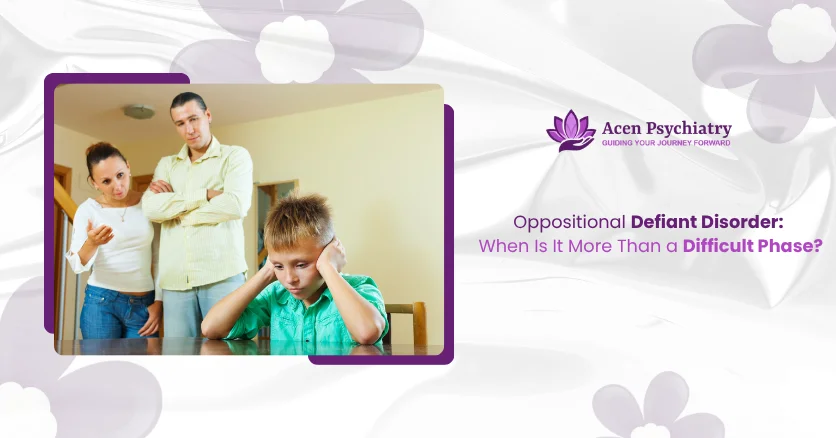
Oppositional Defiant Disorder: When Is It More Than a DifficultPhase?

Every child argues, pushes back, and tests limits sometimes — it’s a normal part of development, especially during
certain ages and transitions. But for some children, defiance, anger, and conflict with authority figures become the
dominant pattern, persisting well beyond what’s typical and significantly disrupting family life, school, and friendships.
When that happens, it may be Oppositional Defiant Disorder, a recognized and treatable condition — not simply a
parenting failure or a “bad kid.”

What ODD Actually Looks Like

Oppositional Defiant Disorder involves a persistent pattern, lasting at least six months, of:

Angry and irritable mood, including frequently losing their temper, being easily annoyed, and seeming chronically
angry or resentful.

Argumentative and defiant behavior, including arguing with adults, actively defying or refusing to comply with rules
and requests, deliberately annoying others, and blaming others for their own mistakes or misbehavior.

Vindictiveness, including spitefulness or seeking revenge at least a couple of times in the past six months.

Importantly, these behaviors need to occur across more than one setting (not just with one parent, or only at home, or
only at school) and need to be more frequent and intense than what’s typical for the child’s age and developmental
stage.

How This Is Different From Typical Childhood Pushback

Nearly every toddler has tantrums. Nearly every teenager argues with their parents. The question with ODD isn’t
whether a child ever pushes back — it’s whether the pattern is persistent, pervasive, and disproportionate.

A few distinguishing questions:

  • Is the defiance happening almost daily, rather than occasionally during expected developmental friction?
  • Is it showing up across multiple relationships and settings, not just with one specific person or in one specific
    context?
  • Has it lasted six months or more, rather than being tied to a recent, specific stressor that should resolve?
  • Is it significantly disrupting family functioning, friendships, or school, beyond ordinary parent-child conflict?

A child who’s difficult with one strict teacher but fine everywhere else is showing something different from a child
whose anger and defiance show up with parents, teachers, coaches, and peers alike.

What’s Actually Going On Underneath

It’s easy to see oppositional behavior and assume the child is simply choosing to be difficult. In reality, ODD often
reflects underlying difficulties with emotional regulation — these are often children who feel emotions, especially
frustration and perceived injustice, more intensely than their peers, and who haven’t yet developed the skills to manage
and express that intensity in more flexible ways.

Contributing factors can include:

  • Difficulty with emotional regulation and frustration tolerance
  • Co-occurring ADHD (very common alongside ODD)
  • Family stress, inconsistency in discipline, or significant life disruptions
  • Learning differences that create chronic frustration, particularly at school
  • A temperament that’s naturally more intense or reactive

None of this means a child “can’t help it” in a way that removes the need for structure and consequences — but it does
mean the most effective interventions focus on building skills, not just imposing punishment.

Why Getting an Accurate Picture Matters

ODD frequently overlaps with other conditions, and behavior that looks oppositional on the surface sometimes has a
different underlying driver entirely — undiagnosed ADHD, anxiety, a learning disability, or even depression in some
children, which can present as irritability rather than sadness. A careful evaluation looks at the whole picture rather
than assuming the most visible behavior is the whole story.

You’re Not Failing as a Parent

If you’re living with a child who seems to fight you on everything, it’s exhausting, and it’s easy to internalize that as a
parenting failure. It usually isn’t. ODD responds well to the right kind of structured support — both for the child and for
the parents navigating it day to day. Getting an evaluation isn’t giving up or labeling your child; it’s the first step toward
something that actually works better than what you’ve likely already tried.

Acen Integrative Psychiatric Services provides evaluation and treatment for ODD and related behavioral concerns in
children and adolescents, via telehealth across California, Oregon, and Illinois, with in-person visits available by
request.

Want to talk through what you’re seeing at home? Book an appointment or contact us — we’re glad to help you
figure out the next step.

This article is for educational purposes and is not a substitute for a clinical evaluation. If you have concerns about your child’s behavior or development, please consult a licensed provider.

Bipolar Disorder Treatment Medication, Therapy, and Building Stability

Bipolar Disorder Treatment: Medication, Therapy, and BuildingStability

A bipolar disorder diagnosis can feel overwhelming at first, but it’s important to know this clearly: bipolar disorder is
highly treatable, and most people who stay engaged in treatment achieve real, lasting stability. Treatment looks
different from standard depression care, which is part of why an accurate diagnosis matters so much. Here’s what
effective treatment actually involves.

Medication: The Foundation of Treatment

Unlike major depression, where therapy alone is sometimes sufficient, bipolar disorder almost always requires
medication as a core part of treatment, alongside any therapy.

Mood stabilizers (such as lithium and certain anticonvulsants) are often the foundation of treatment, working to
prevent both manic and depressive episodes rather than targeting just one mood state.

Atypical antipsychotics are frequently used as well, either alone or alongside a mood stabilizer, and have strong
evidence for treating both manic and depressive episodes in bipolar disorder.

Antidepressants are used more cautiously in bipolar disorder than in unipolar depression, typically only alongside a
mood stabilizer and often for shorter durations, due to the risk of triggering mania or mood instability when used alone.

A few honest things about bipolar medication management:

  • Finding the right medication or combination often takes time and adjustment. This isn’t a sign that nothing
    will work — mood stabilizer and antipsychotic response varies significantly between individuals.
  • Consistency matters enormously. Skipping doses or stopping medication abruptly is one of the most common
    triggers for relapse, even when someone has been stable for a long time.
  • Regular monitoring is part of the process, including periodic bloodwork for certain medications (like lithium) to
    ensure levels stay in a safe, effective range.
  • Stopping medication during a stable period is one of the highest-risk decisions in bipolar treatment and
    should always be a carefully considered, collaborative decision with your provider, not something to do
    independently because you’re feeling well.

Therapy’s Role

While medication is foundational, therapy adds meaningful value alongside it:

Psychoeducation — understanding your own early warning signs, triggers, and patterns — is one of the most
practically useful tools in bipolar treatment, helping you and your support system recognize an emerging episode
before it fully develops.

Cognitive Behavioral Therapy (CBT), adapted for bipolar disorder, can help manage depressive symptoms and
address the thought patterns that contribute to both depressive and manic episodes.

Interpersonal and Social Rhythm Therapy (IPSRT) focuses specifically on stabilizing daily routines — sleep, meals,
activity — since disruptions to these rhythms are a well-documented trigger for mood episodes in bipolar disorder.

Family-focused therapy can help loved ones understand the condition, recognize early warning signs, and respond in
ways that support stability rather than inadvertently escalating conflict during mood episodes.

Lifestyle Factors That Genuinely Matter

For bipolar disorder specifically, certain lifestyle factors aren’t just generally healthy — they directly affect mood
stability:

  • Sleep regularity is one of the most significant, well-documented triggers for manic episodes. Maintaining a
    consistent sleep schedule is a clinical priority, not just a wellness suggestion.
  • Avoiding alcohol and recreational substances, which can both trigger episodes and interact dangerously with
    mood-stabilizing medications.
  • Maintaining routine, particularly around sleep, meals, and daily structure, supports the kind of stability that
    reduces episode frequency over time.
  • Identifying personal early warning signs — for some people, subtle changes in sleep, energy, or thought patterns
    precede a full episode by days, giving a real window to intervene early with your treatment team.

Building a Long-Term Plan

Bipolar disorder is a long-term condition, and treatment is generally ongoing rather than time-limited, even during
periods of full stability. This isn’t a discouraging fact — many chronic health conditions work the same way, and
ongoing treatment is exactly what allows most people with bipolar disorder to maintain stability and live full lives. The
goal of treatment isn’t to “graduate” from care, but to build a sustainable, collaborative relationship with a provider
who knows your history and can help you stay ahead of emerging episodes.

If you’ve been recently diagnosed, or have been managing bipolar disorder for years and feel like your current
treatment isn’t quite working, it’s worth revisiting your plan with a provider who takes the time to understand your
specific pattern.

Acen Integrative Psychiatric Services offers comprehensive bipolar disorder treatment, including medication
management and coordination with therapy, for adult patients across California, Oregon, and Illinois via telehealth,
with in-person visits available by request.

Ready to build a plan for real stability? Book an appointment or contact us — we’re glad to talk through your
options.

This article is for educational purposes and is not a substitute for a clinical evaluation. If you are in crisis or having thoughts of suicide, please call or text 988, or go to your nearest emergency room

Bipolar Disorder vs  Depression Why Misdiagnosis Is So Common

Bipolar Disorder vs. Depression: Why Misdiagnosis Is So Common

One of the most clinically significant problems in psychiatry is how often bipolar disorder gets misdiagnosed as major
depression. It’s not a rare error — research has consistently shown that a substantial portion of people eventually
diagnosed with bipolar disorder were initially treated for depression alone, sometimes for years, before the full picture
became clear. Understanding why this happens can help you advocate for a more accurate evaluation, whether for
yourself or someone you care about.

Why the Confusion Happens

Depression is usually what brings people in. People with bipolar disorder are far more likely to seek help during a
depressive episode than during a manic or hypomanic one. Mania and hypomania often don’t feel like a problem from
the inside — sometimes they feel like the best version of yourself — so they’re far less likely to prompt someone to seek
treatment.

Hypomania is easy to miss without specifically asking. Unlike full mania, hypomanic episodes don’t typically
involve hospitalization, psychosis, or behavior so extreme that it’s obviously alarming. A period of feeling unusually
energetic, productive, and confident can easily be remembered as “a good stretch” rather than reported as a symptom,
unless a clinician specifically screens for it.

Symptoms can look similar on the surface. Irritability, anger, and agitation can appear in both bipolar depression
and unipolar (major) depression, which can blur the distinction without careful, detailed history-taking.

The depressive episodes in bipolar disorder often look identical to major depression. There’s no symptom
checklist that reliably tells the two apart just by looking at a depressive episode in isolation — the distinguishing factor
is whether there’s also a history of manic or hypomanic episodes, which requires deliberately asking about the past, not
just the present.

Why Getting This Right Matters So Much

This isn’t just an academic distinction — misdiagnosis has real treatment consequences.

Antidepressants alone can trigger mania in someone with bipolar disorder. Treating bipolar depression the
same way as major depression — with an antidepressant alone, without a mood stabilizer — carries a real risk of
triggering a manic or hypomanic episode, or contributing to mood instability and rapid cycling between episodes.

The wrong treatment can make things worse, not just ineffective. Someone who’s actually experiencing bipolar
depression but is treated only for unipolar depression may not just fail to improve — they may become more unstable,
which can be more disruptive than the original depression itself.

An accurate diagnosis changes the entire treatment plan. Bipolar disorder typically requires mood stabilizers or
specific atypical antipsychotics as foundational treatment, often with antidepressants used cautiously and selectively, if
at all — a fundamentally different approach than standard depression treatment.

Signs That Warrant a Closer Look for Bipolar Disorder

If you’re being treated for depression, it’s worth specifically discussing the possibility of bipolar disorder with your
provider if any of the following apply:

  • You’ve had distinct periods of unusually elevated mood, energy, or decreased need for sleep, even if they didn’t seem
    like a “problem” at the time
  • Antidepressants have made you feel agitated, wired, or unusually elevated, rather than simply better
  • You have a family history of bipolar disorder
  • Your depressive episodes started at a younger age (bipolar disorder often has an earlier age of onset than typical
    unipolar depression)
  • You’ve had multiple depressive episodes that don’t respond well to standard antidepressant treatment
  • Your mood episodes seem to follow a more episodic, on-and-off pattern rather than a single sustained depressive
    period

None of these alone confirms bipolar disorder, but they’re exactly the kind of detail that should prompt a more
thorough evaluation rather than continuing with the same treatment approach if it isn’t working.

What a More Thorough Evaluation Looks Like

A careful evaluation for mood symptoms includes specific, detailed questions about past periods of elevated mood or
energy — not just current symptoms — along with family history, the pattern and timing of past episodes, and how
you’ve responded to any previous treatment. This kind of detailed history is what makes the difference between an
accurate diagnosis and years of treating only part of the picture.
If you’ve been treated for depression without much improvement, or treatment has had an unexpected effect, it’s worth
raising the possibility of bipolar disorder directly, even if no one has brought it up before.
Acen Integrative Psychiatric Services provides thorough mood disorder evaluations, including careful screening for
bipolar disorder, for adult patients via telehealth across California, Oregon, and Illinois, with in-person visits available
by request.

Wondering if your depression treatment is missing something? Book an appointment or contact us — we’re
glad to take a closer look.

This article is for educational purposes and is not a substitute for a clinical evaluation. If you are in crisis or having thoughts of suicide, please call or text 988, or go to your nearest emergency room.

Bipolar Disorder Recognizing the Signs Beyond Mood Swings

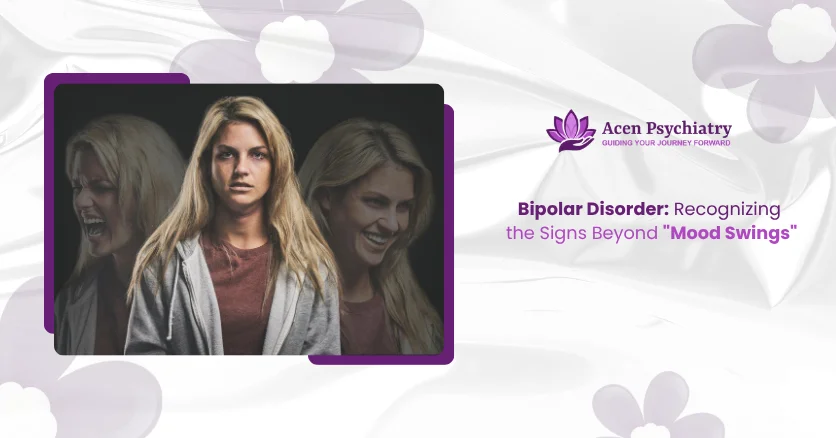
Bipolar Disorder: Recognizing the Signs Beyond “Mood Swings”

“Bipolar” has become a casual shorthand for anyone who’s moody or unpredictable, which has done real damage to
public understanding of what the condition actually involves. Bipolar disorder isn’t about having a short temper or
changing your mind quickly — it’s a pattern of distinct mood episodes, each lasting days to weeks, that represent a real
shift away from a person’s baseline functioning. Understanding what those episodes actually look like is the first step
toward recognizing the condition in yourself or someone you care about.

What Bipolar Disorder Actually Involves

Bipolar disorder is characterized by episodes of mania or hypomania, usually alternating with episodes of depression.
There are a few recognized types, but the core features are similar.

Manic episodes involve a distinct period, lasting at least a week, of abnormally elevated, expansive, or irritable mood
along with increased energy, including:

  • Decreased need for sleep (feeling rested after very little sleep, not just difficulty sleeping)
  • Inflated self-esteem or grandiosity
  • Being more talkative than usual, or feeling pressure to keep talking
  • Racing thoughts or the experience of thoughts moving faster than they can be expressed
  • Distractibility
  • Increased goal-directed activity, sometimes starting many projects at once
  • Engaging in risky behavior with poor judgment of consequences — impulsive spending, risky sexual behavior,
    impulsive decisions

In severe cases, mania can include psychotic symptoms (delusions or hallucinations) and may require hospitalization.

Hypomanic episodes involve the same general symptom pattern as mania, but less severe and shorter (at least four
days), without the level of impairment that disrupts functioning to the same degree, and without psychotic features.

Depressive episodes in bipolar disorder look similar to major depression: persistent low mood, loss of interest in
activities, changes in sleep and appetite, fatigue, difficulty concentrating, feelings of worthlessness, and in severe
cases, thoughts of suicide.

Why “Mood Swings” Is the Wrong Frame

The term “mood swings” suggests rapid, frequent shifts — moody one moment, fine the next. Bipolar disorder doesn’t
typically work that way. Episodes last days to weeks at minimum, represent a sustained departure from a person’s
normal functioning, and are often followed by periods of relative stability in between. Someone with bipolar disorder
isn’t unpredictable from hour to hour; they experience distinct, sustained episodes that are different from their usual
self.

This distinction matters because it’s exactly why bipolar disorder is so often missed: the day-to-day irritability or quick
temper many people associate with the term isn’t actually what defines the condition.

What Hypomania Can Look Like From the Inside

Hypomania, in particular, often doesn’t feel like a problem while it’s happening — sometimes the opposite. People often
describe feeling unusually productive, confident, creative, or sociable. This is part of why hypomanic episodes
frequently go unreported: by the time someone seeks help, it’s often during the depressive phase, and the preceding
hypomanic episode may not come up unless specifically asked about.

This is one of the most clinically important reasons a thorough history matters — without specifically asking about past
periods of unusually elevated mood, energy, or behavior, it’s easy for bipolar disorder to be missed entirely, sometimes
for years.

When to Seek an Evaluation

If you’ve experienced distinct periods of unusually elevated mood, energy, or impulsivity — lasting days, not hours —
alongside separate periods of depression, it’s worth bringing this up specifically in an evaluation, even if you’ve
previously been treated only for depression. Family history of bipolar disorder is also relevant to mention, as the
condition has a strong genetic component.

If you are having thoughts of suicide or self-harm, please reach out immediately. Call or text 988 (the Suicide & Crisis
Lifeline) any time, or go to your nearest emergency room.

Bipolar Disorder Is Manageable

With an accurate diagnosis and the right treatment, bipolar disorder is very manageable. Many people achieve real
stability and go on to live full, productive lives. The key first step is recognizing the actual pattern, not the popularized
version of the term.

Acen Integrative Psychiatric Services provides comprehensive evaluation and treatment for bipolar disorder for adult
patients, via telehealth across California, Oregon, and Illinois, with in-person visits available by request.
Recognize this pattern in yourself or someone you love? Book an appointment or contact us with any
questions.

This article is for educational purposes and is not a substitute for a clinical evaluation. If you are in crisis or having thoughts of suicide, please call or text 988, or go to your nearest emergency room.

Getting Diagnosed With ADHD as an Adult Woman What to Expect

Getting Diagnosed With ADHD as an Adult Woman: What to Expect

If you’re considering an ADHD evaluation as an adult woman, there’s a good chance you’re carrying some skepticism
into it — maybe from a past experience of being dismissed, told you were “just anxious,” or simply doubting whether
your struggles are “ADHD enough” to count. That skepticism is understandable, and it’s also worth setting aside long
enough to get an evaluation from a provider who actually knows what to look for. Here’s what the process realistically involves.

Why Your Evaluation Should Look Different Than You Expect

Many standard ADHD assessments were built around the hyperactive, externally disruptive presentation more
commonly seen in boys, which means a generic evaluation can genuinely miss ADHD in women whose symptoms look
different. A thorough evaluation for adult women should specifically account for:

  • The inattentive presentation, rather than focusing primarily on hyperactivity
  • A developmental history that considers how symptoms may have been masked, missed, or misattributed throughout
    childhood and adolescence
  • The possibility of co-occurring anxiety or depression that developed as a consequence of years of undiagnosed
    ADHD, rather than assuming those are the only things going on
  • Hormonal patterns and how symptoms may have fluctuated across your cycle, pregnancy, or other transitions
  • The toll of masking — chronic exhaustion, perfectionism, and self-criticism that often accompany years of
    compensating

If a provider’s questions only focus on classic hyperactive symptoms, that’s a sign the evaluation may not be capturing
your actual presentation.

What the Evaluation Process Involves

A detailed developmental history. Since ADHD symptoms are required to have been present since childhood, your
provider will ask about your school years, even if no one suspected ADHD at the time. Report cards described as “bright
but disorganized,” “talks a lot,” or “could do better if she tried” are common retrospective clues, even decades later.

Current symptom assessment. A conversation about how things look now — at work, at home, in relationships —
including the specific ways you’ve adapted or compensated, since masking can make standard symptom checklists
underrepresent the real impact.

Standardized rating scales. Self-report questionnaires that capture your day-to-day experience, often including
versions specifically designed to better capture the inattentive and internalized symptoms more common in women.

Objective testing. Computerized testing tools like QbTest or QbCheck provide measurable, objective data on attention
and impulsivity, adding a layer of evidence beyond self-report alone — which can be especially validating if you’ve
previously doubted whether your experience was “real.”

Ruling out overlapping conditions. Anxiety, depression, thyroid conditions, sleep disorders, and hormonal factors
can all mimic or compound ADHD symptoms, so a thorough evaluation considers the full picture rather than assuming
the most obvious explanation.

If You’ve Been Dismissed Before

If a previous provider told you that you couldn’t have ADHD because you did well in school, weren’t disruptive, or
seemed “too put together,” that assessment was very likely incomplete. High academic or professional achievement
doesn’t rule out ADHD — many women succeed by working far harder than necessary to mask underlying struggles,
often at a real personal cost that isn’t visible from the outside. A thorough evaluation should take your full lived
experience seriously, not just whether your symptoms match an outdated stereotype.

What Happens After Diagnosis

If you’re diagnosed with ADHD, treatment is built around your specific presentation and life circumstances, which
might include:

  • Medication management, with attention to how your symptoms may fluctuate with hormonal changes over time
  • Behavioral and organizational strategies tailored to how ADHD actually shows up for you, not generic productivity
    advice
  • Addressing any co-occurring anxiety or depression as part of a complete plan
  • Ongoing follow-up that adjusts as your life circumstances and hormonal stages change

Giving Yourself Permission to Find Out

You don’t need to justify why you’re seeking an evaluation, and you don’t need to have struggled in a particular visible
way to deserve one. If you’ve spent years wondering why ordinary life feels so much harder than it seems to for people
around you, that’s reason enough to get a real, thorough answer.
Acen Integrative Psychiatric Services provides comprehensive ADHD evaluations for adult women, with particular
attention to the inattentive presentation, masking, and hormonal factors that are often missed elsewhere. We see
patients via telehealth across California, Oregon, and Illinois, with in-person visits available by request.
Ready to get an evaluation that actually sees the full picture? Book an appointment or contact us with any
questions.
This article is for educational purposes and is not a substitute for a clinical evaluation. If you’re concerned about ADHD, please consult a licensed provider

ADHD and Hormones Why Your Symptoms Might Worsen With Your Cycle, Pregnancy, or Menopause

ADHD and Hormones: Why Your Symptoms Might Worsen WithYour Cycle, Pregnancy, or Menopause

If you have ADHD, you may have noticed that your symptoms aren’t constant — some weeks feel manageable, others
feel like everything you’ve built to cope with ADHD has simply stopped working. This isn’t inconsistency or a lack of
discipline. Estrogen has a direct, well-documented relationship with dopamine regulation in the brain, which means
hormonal fluctuations can meaningfully affect ADHD symptoms throughout a woman’s life. Understanding this
connection can help explain patterns that might otherwise feel confusing or frustrating.

The Estrogen-Dopamine Connection

Estrogen supports dopamine production and the sensitivity of dopamine receptors in the brain. Since ADHD is
fundamentally tied to dopamine regulation, fluctuations in estrogen can directly affect how pronounced ADHD
symptoms feel at any given time. When estrogen drops, dopamine function tends to drop with it — and ADHD symptoms
often follow.

Throughout the Menstrual Cycle

Many women with ADHD notice a predictable pattern tied to their cycle:

The luteal phase (roughly the one to two weeks before your period), when estrogen drops, is when many women
notice their ADHD symptoms intensify — increased forgetfulness, more difficulty concentrating, heightened emotional
sensitivity, and a noticeable dip in the coping strategies that otherwise work.

Around ovulation, when estrogen peaks, many women notice the opposite: sharper focus, more energy, and an easier
time managing tasks that feel much harder at other points in the cycle.
If you’ve ever wondered why some weeks you feel like you have it together and others you feel like everything is falling
apart despite nothing else changing, your cycle may be part of the explanation.

Pregnancy

Pregnancy involves dramatic hormonal shifts, and the effect on ADHD symptoms varies significantly between
individuals — some women notice improvement, particularly in the second trimester when estrogen rises substantially,
while others experience worsening symptoms, especially in the first trimester or postpartum period. Pregnancy also
frequently requires reassessing medication, since some ADHD medications carry different risk profiles during
pregnancy and breastfeeding, which makes working closely with a provider during this time especially important.

Postpartum

The postpartum period involves a sharp drop in estrogen, combined with significant sleep deprivation and an enormous
increase in cognitive and logistical demands. For women with existing ADHD, this combination can be especially
difficult, and for some women, postpartum is when ADHD is recognized for the first time — the cognitive demands of
caring for a newborn can overwhelm coping mechanisms that worked previously, making underlying ADHD newly
visible.

Perimenopause and Menopause

Perimenopause — the transitional years before menopause — involves significant, often unpredictable estrogen
fluctuations, and many women describe this period as when ADHD symptoms become dramatically worse, sometimes
for the first time prompting a diagnosis later in life. Common experiences during this transition include:

  • A noticeable decline in memory and word-finding ability
  • Increased difficulty with focus and follow-through
  • Heightened emotional reactivity
  • A feeling that long-standing coping strategies have suddenly stopped working

This is sometimes mistaken purely for “menopause brain fog,” and while hormonal changes do affect cognition for
everyone during this transition, women with underlying ADHD often experience a more pronounced effect, since the
same dopamine-estrogen relationship that affected their cycle for decades is now shifting in a more sustained way.

Why This Connection Matters for Treatment

Understanding the hormone-ADHD relationship matters for a few practical reasons:

Medication needs may shift over time. What worked well for years may need adjustment during pregnancy,
postpartum, or perimenopause, and this is a normal part of ongoing ADHD management rather than a sign that
something has gone wrong.

Cyclical symptom tracking can be genuinely useful. Some women benefit from tracking symptoms alongside their
cycle to identify patterns, which can inform timing of strategies or, in some cases, medication adjustments.

This isn’t “just hormones” dismissing real symptoms. Recognizing a hormonal influence on ADHD symptoms
doesn’t mean the symptoms aren’t real or significant — it means there’s an additional layer of context that can inform a more effective, individualized treatment approach.

Getting Support That Accounts for the Full Picture

If your ADHD symptoms have felt unpredictable in ways that seem tied to your cycle, pregnancy, postpartum, or the
menopause transition, that’s a legitimate pattern worth discussing with a provider who understands this connection,
rather than something to dismiss as inconsistency on your part.
Acen Integrative Psychiatric Services provides ADHD evaluation and treatment for women across the lifespan,
including thoughtful medication management during pregnancy, postpartum, and perimenopause, via telehealth across
California, Oregon, and Illinois, with in-person visits available by request.

Noticing a pattern with your symptoms? Book an appointment or contact us — we’re glad to help you
understand what’s going on.
This article is for educational purposes and is not a substitute for a clinical evaluation. If you’re concerned about ADHD or have questions
about medication during pregnancy or breastfeeding, please consult a licensed provider

ADHD in Women Why It's Missed and What It Actually Looks Like

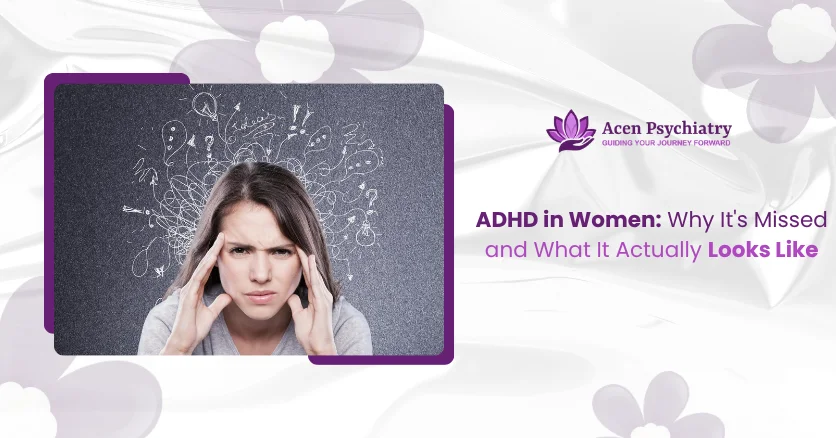
ADHD in Women: Why It’s Missed and What It Actually Looks Like

ADHD research, diagnostic criteria, and public perception were shaped for decades almost entirely around how the
condition presents in boys — hyperactive, disruptive, impossible to miss in a classroom. The result is that generations of
girls grew into women whose ADHD went unrecognized, often for decades, simply because it didn’t look like what
anyone was trained to see. If you’ve wondered whether your lifelong struggles with focus, overwhelm, or “keeping it
together” point to something more, you’re far from alone.

Why ADHD Looks Different in Women

ADHD in women is far more likely to present as the inattentive type, rather than the hyperactive-impulsive presentation
more commonly seen and recognized in boys. This often looks like:

  • Daydreaming, mentally “checking out,” or difficulty staying present in conversations or tasks
  • Chronic disorganization that you’ve spent years building elaborate systems to manage
  • Feeling mentally scattered or like you’re juggling too many half-finished thoughts at once
  • Sensory sensitivity or feeling easily overwhelmed by noise, clutter, or too much happening at once
  • Internal restlessness rather than visible hyperactivity — a racing mind rather than a fidgety body
  • Emotional sensitivity and intense reactions that feel disproportionate to the situation
  • Chronic lateness or time blindness, despite genuinely trying to manage your schedule

None of this looks like the stereotype of a child bouncing off the walls, which is exactly why it’s so often missed —
including by the woman experiencing it.

Masking: Why So Many Women Fly Under the Radar

Many women with ADHD become highly skilled at masking — consciously or unconsciously compensating for symptoms
in ways that hide the underlying struggle from others, and sometimes from themselves. This can look like:

  • Working far harder and longer than peers to produce comparable results
  • Building rigid routines and systems that fall apart spectacularly when disrupted
  • Over-apologizing or over-explaining minor mistakes out of fear of being seen as careless
  • Staying quiet in social or work settings to avoid the risk of saying something impulsive
  • Internalizing struggles as personal failures — “I’m just lazy” or “I’m bad at adulting” — rather than recognizing a
    treatable pattern

Masking often works, at least for a while. But it comes at a real cost: chronic exhaustion, anxiety, and a persistent sense
of falling short despite working harder than people around you. Many women describe finally reaching a breaking point
— often during a major life transition — when masking simply stops being sustainable.

The Life Transitions That Often Bring It to a Head

A lot of women aren’t diagnosed until adulthood, often triggered by:
Becoming a parent. The cognitive load of caring for a child can overwhelm coping systems that previously worked,
and many mothers are diagnosed shortly after recognizing the same traits in their own child.
A major career change or promotion. New responsibilities, especially those requiring more independent
organization, can break down systems that worked in a more structured environment.
Hormonal shifts. Puberty, postpartum, and perimenopause can all worsen ADHD symptoms significantly, sometimes
severely enough to finally prompt an evaluation.

Why Misdiagnosis Is So Common

Women with ADHD are frequently diagnosed first with anxiety or depression — and often, they do have anxiety or
depression, but as a downstream consequence of years of undiagnosed ADHD, chronic overwhelm, and self-blame,
rather than as the root cause. Treating the anxiety or depression alone, without addressing the underlying ADHD, often
leads to partial improvement at best, with the core struggles persisting.

You’re Not Behind, and You’re Not “Too Old” to Find Out

If you’ve spent years wondering why ordinary life feels harder for you than it seems to for everyone else, that question
deserves a real answer — at any age. An accurate diagnosis doesn’t just provide a label; it provides an explanation that
can finally make sense of a lifetime of experiences, along with a path toward treatment that actually addresses what’s
going on.
Acen Integrative Psychiatric Services provides comprehensive ADHD evaluations for adult women, combining clinical
history with objective testing to reach an accurate diagnosis. We see patients via telehealth across California, Oregon,
and Illinois, with in-person visits available by request.

Ready to get some answers? Book an appointment or contact us with any questions.

This article is for educational purposes and is not a substitute for a clinical evaluation. If you’re concerned about ADHD or another mental health condition, please consult a licensed provider.