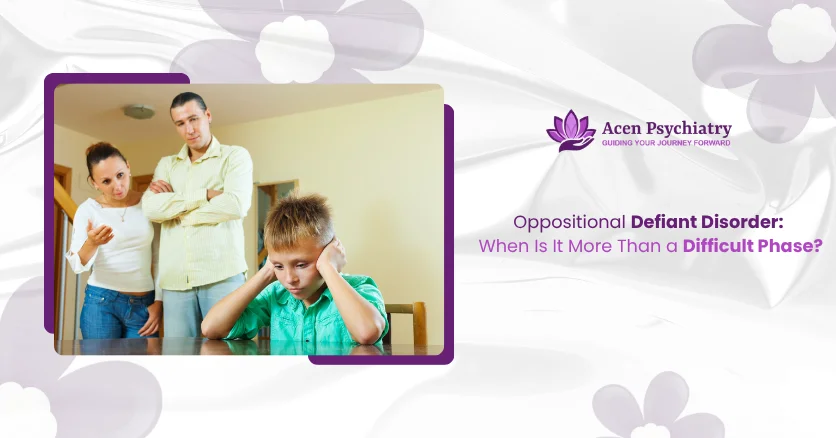
Oppositional Defiant Disorder: When Is It More Than a DifficultPhase?

Every child argues, pushes back, and tests limits sometimes — it’s a normal part of development, especially during
certain ages and transitions. But for some children, defiance, anger, and conflict with authority figures become the
dominant pattern, persisting well beyond what’s typical and significantly disrupting family life, school, and friendships.
When that happens, it may be Oppositional Defiant Disorder, a recognized and treatable condition — not simply a
parenting failure or a “bad kid.”
What ODD Actually Looks Like
Oppositional Defiant Disorder involves a persistent pattern, lasting at least six months, of:
Angry and irritable mood, including frequently losing their temper, being easily annoyed, and seeming chronically
angry or resentful.
Argumentative and defiant behavior, including arguing with adults, actively defying or refusing to comply with rules
and requests, deliberately annoying others, and blaming others for their own mistakes or misbehavior.
Vindictiveness, including spitefulness or seeking revenge at least a couple of times in the past six months.
Importantly, these behaviors need to occur across more than one setting (not just with one parent, or only at home, or
only at school) and need to be more frequent and intense than what’s typical for the child’s age and developmental
stage.
How This Is Different From Typical Childhood Pushback
Nearly every toddler has tantrums. Nearly every teenager argues with their parents. The question with ODD isn’t
whether a child ever pushes back — it’s whether the pattern is persistent, pervasive, and disproportionate.
A few distinguishing questions:
- Is the defiance happening almost daily, rather than occasionally during expected developmental friction?
- Is it showing up across multiple relationships and settings, not just with one specific person or in one specific
context? - Has it lasted six months or more, rather than being tied to a recent, specific stressor that should resolve?
- Is it significantly disrupting family functioning, friendships, or school, beyond ordinary parent-child conflict?
A child who’s difficult with one strict teacher but fine everywhere else is showing something different from a child
whose anger and defiance show up with parents, teachers, coaches, and peers alike.
What’s Actually Going On Underneath
It’s easy to see oppositional behavior and assume the child is simply choosing to be difficult. In reality, ODD often
reflects underlying difficulties with emotional regulation — these are often children who feel emotions, especially
frustration and perceived injustice, more intensely than their peers, and who haven’t yet developed the skills to manage
and express that intensity in more flexible ways.
Contributing factors can include:
- Difficulty with emotional regulation and frustration tolerance
- Co-occurring ADHD (very common alongside ODD)
- Family stress, inconsistency in discipline, or significant life disruptions
- Learning differences that create chronic frustration, particularly at school
- A temperament that’s naturally more intense or reactive
None of this means a child “can’t help it” in a way that removes the need for structure and consequences — but it does
mean the most effective interventions focus on building skills, not just imposing punishment.
Why Getting an Accurate Picture Matters
ODD frequently overlaps with other conditions, and behavior that looks oppositional on the surface sometimes has a
different underlying driver entirely — undiagnosed ADHD, anxiety, a learning disability, or even depression in some
children, which can present as irritability rather than sadness. A careful evaluation looks at the whole picture rather
than assuming the most visible behavior is the whole story.
You’re Not Failing as a Parent
If you’re living with a child who seems to fight you on everything, it’s exhausting, and it’s easy to internalize that as a
parenting failure. It usually isn’t. ODD responds well to the right kind of structured support — both for the child and for
the parents navigating it day to day. Getting an evaluation isn’t giving up or labeling your child; it’s the first step toward
something that actually works better than what you’ve likely already tried.
Acen Integrative Psychiatric Services provides evaluation and treatment for ODD and related behavioral concerns in
children and adolescents, via telehealth across California, Oregon, and Illinois, with in-person visits available by
request.
Want to talk through what you’re seeing at home? Book an appointment or contact us — we’re glad to help you
figure out the next step.
This article is for educational purposes and is not a substitute for a clinical evaluation. If you have concerns about your child’s behavior or development, please consult a licensed provider.