
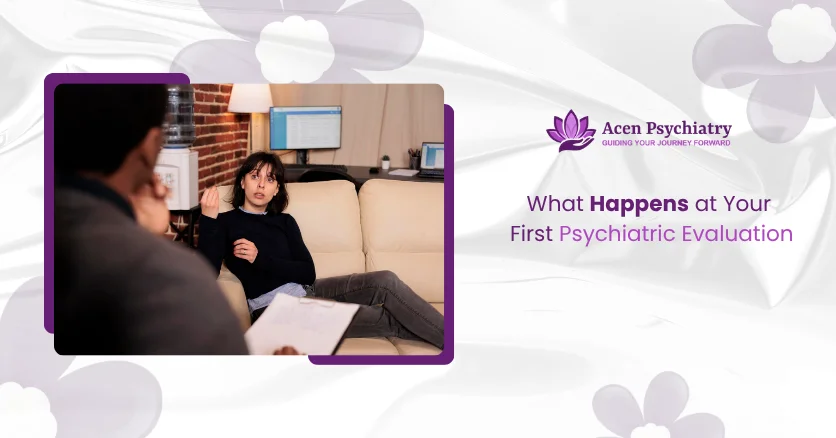
What Happens at Your First Psychiatric Evaluation

Not knowing what to expect is one of the biggest reasons people delay booking a first psychiatric appointment. The unknown is often more intimidating than the appointment itself turns out to be.
Here’s a clear, honest walkthrough of what actually happens, so you can walk in knowing what to expect instead of guessing.
Before Your Appointment
Most practices, including ours, send intake paperwork ahead of time — typically history forms and symptom questionnaires you complete online before your visit.
This isn’t a test with right or wrong answers; it simply gives your provider helpful background so the appointment itself can focus on conversation rather than paperwork.
Answer as honestly as you can, even if some answers feel uncomfortable or embarrassing. Providers have heard it before, and accurate information leads to a more accurate evaluation.
The Evaluation Itself
A first psychiatric evaluation is, at its core, a structured conversation. Here’s generally what it covers:
What’s brought you in.
Your provider will start by asking what’s been going on — your current symptoms, concerns, and what prompted you to seek help now.
History of the symptoms.
When things started, how they’ve changed over time, what makes them better or worse, and how they’re affecting your daily life — work, relationships, sleep, physical health.
Your broader history.
This typically includes your medical history, any past mental health treatment, family mental health history, and relevant life circumstances.
None of this needs to be perfectly organized in your head beforehand — providers are skilled at asking follow-up questions to draw out relevant details.
Current life context.
Major stressors, support systems, substance use, sleep patterns, and anything else relevant to understanding the full picture of your life right now, not just your symptoms in isolation.
Questions you have.
A good evaluation is a two-way conversation. You should leave feeling like you understood what was discussed and had room to ask your own questions, not like you were simply processed through a checklist.
What Happens at the End
By the end of a thorough evaluation, your provider should be able to offer some combination of:
- A clinical impression of what’s going on, which may be a specific diagnosis, multiple contributing factors, or — sometimes — a need for further evaluation or monitoring before things are fully clear
- A discussion of treatment options, which might include medication, therapy referrals, lifestyle changes, or a combination, along with honest information about what each option involves
- A collaborative plan for next steps, built around your preferences and circumstances, not a generic one-size-fits-all protocol
It’s completely normal for some uncertainty to remain after a first visit, especially for more complex presentations.
Psychiatric evaluation is sometimes an ongoing process rather than a single definitive verdict, and follow-up appointments allow your provider to refine the picture as they get to know you and how you respond to any treatment that’s started.
How Long Does It Take?
Initial psychiatric evaluations are typically longer than routine follow-up visits — often 45 minutes to an hour — specifically because there’s a lot of relevant history and context to cover.
Follow-up appointments are usually shorter, focused on how you’re doing and adjusting the plan as needed.
What If I Get Emotional, or Don’t Know How to Answer Something?
That’s genuinely fine.
Providers are used to people getting emotional, struggling to find words, or saying “I don’t know” to a question.
You’re not expected to have polished, complete answers. Take your time, and know that “I’m not sure how to describe it, but…” is a perfectly reasonable way to start a sentence in this setting.
You Don’t Have to Have It All Figured Out
If the uncertainty of “I don’t know what this appointment will be like” has been part of what’s kept you from booking, hopefully this offers enough of a clear picture to make that first step feel less daunting.
The rest is simply a conversation, guided by someone whose job is to help make sense of it with you.
Acen Integrative Psychiatric Services offers psychiatric evaluations for patients ages 6 to 64 via telehealth across California, Oregon, and Illinois, with in-person visits available by request.
Ready to schedule your first visit? Book an appointment or contact us with any questions before you do.
This article is for educational purposes and is not a substitute for a clinical evaluation. If you are in crisis or having thoughts of suicide, please call or text 988, or go to your nearest emergency room.